Search This Blog

De Omnibus Dubitandum - Lux Veritas

Showing posts with label GMO. Show all posts

Tuesday, June 2, 2020

Year-Long Investigation Refutes Myth of 'Grassroots' Anti-GMO Activism

Anti-GMO groups present themselves to the public as independent truth seekers fighting to build a healthy food system and counter the machinations of "powerful" corporations. A detailed investigation of who funds these groups, and how they spend their massive donations, paints a very different picture.

By Cameron English — May 9, 2020

 For many years, the anti-GMO movement has advanced a compelling narrative about its struggle against the biotech industry—pejoratively referred to as 'Big Ag.' According to this story, organic food activists and environmental groups are independent, grassroots rebels taking on the corporations that seek to control the global food supply with their patented GMO seeds and pesticides. It's a Biblical struggle as far as the activists are concerned: they're David and the agro-chemical industry, led by Monsanto, is Goliath.

This Erin Brockovich-style narrative has undoubtedly convinced many Americans that the biotech industry is spending millions to promote its products, lobby Congress and silence its underdog critics. But as the Genetic Literacy Project (GLP) has documented in its just-released Anti-GMO Advocacy Funding Tracker, the David vs. Goliath framing is suspect at best.

Meet Big Organic

Based on a year-long investigation of tax records and annual reports from hundreds of anti-GMO advocacy groups and their donors, the GLP tracker reveals that, instead of underdogs taking on the corporate establishment, many activist groups are highly skilled public relations operations with big budgets working to demonize crop biotechnology. Over the five-year period 2012-2016, anti-GMO groups received $850,922,324 in donations from organic food companies and wealthy foundations.

 The tracker features an interactive network map illustrating the financial relationships between donors (yellow circles) and recipients (blue circles), as well as exportable financial data and detailed profiles of the top 50 organizations. All the data can be toggled by year and size of the organizations (top 10, 25, 50 etc.) (See this article for an in-depth explanation on how to use the tracker.)

 https://www.acsh.org/sites/default/files/screenshot-top-recipients-anti-gmo-advocacy-funding-tracker-1024x819.png
To Read More.....

Thursday, October 31, 2019

Video: ‘Blood on their hands’—Greens’ resistance to biotechnology blocks sustainable agriculture, climate change innovation, says GLP’s Jon Entine

, | October 30, 2019

Green advocacy groups, mostly based in Europe, are the single biggest impediment to sustainable agriculture, said GLP executive director Jon Entine in an interview with Marcel Bruins, editorial director of European Seed magazine and website.

CRISPR and other gene-editing and New Breeding Techniques are fast being adopted around the world, although many ‘environmental activist’ groups are doing their best to frighten the public and intimidate legislators into erecting insurmountable regulatory barriers. They’ve been largely successful in Europe, which is blocking gene-edited crops under legislation passed in the pre-CRISPR era in 2001, Entine said, but the rest of the world is more open to the innovations.

Entine was interviewed in mid-October at the annual Euroseeds Congress 2019, held in Stockholm............To Read More.........

Sunday, September 15, 2019

GMO's Are Not the Problem. They're the Answer!

By Rich Kozlovich

On September 13, 2019 posted the article, GMO, CRISPR-edited crops can cut pesticide use—if environmental activists do not block them saying:
In 2017, University of Florida plant geneticists Zhonglin Mou and Kevin Folta, along with their team of graduate students, announced a new method to fight common diseases in fruit plants. Their discovery could drastically reduce the use of fungicides if widely implemented by growers. 
Unfortunately, their methods may never be put to use thanks to the controversy surrounding crop biotechnology. 
The research confirms a point that cannot be stressed enough: scientists continue to make agriculture safer and more sustainable with the tools of modern genetics, but activists have waged such an effective scare campaign against crop biotechnology that it often remains unused by industry.
Luddite urban dwellers only consume, they don't produce, so they not only don't realize just how important this is, they don't want to know since environmentalism has become the neo-pagan religion of the urban atheist.  In their worship of the planet they self-righteously believe they're morally superior to the rest of us in their "all natural" views.  It would be nice if they had to take responsibility for the consequences in human suffering they're "all natural" views produced in preventing these major crop engineering advances.

Genetic engineering advances that would have brought Golden Rice to the dinner tables of those in Southeast Asia, whose diet lacks sufficient Vitamin A because rice is the primary carbohydrate source in this area of the world, and as The Golden Rice Project notes:
Rice does not contain any β-carotene (provitamin A), which their body could then convert into vitamin A. Dependence on rice as the predominant food source, therefore, necessarily leads to VAD, most severely affecting small children and pregnant women. In 2012 the World Health Organization reported that about 250 million preschool children are affected by VAD, and that providing those children with vitamin A could prevent about a third of all under-five deaths, which amounts to up to 2.7 million children that could be saved from dying unnecessarily. "
This picture is from the Golden Rice Project
The map shows the vast areas impacted by this problem, which gives you an idea of how many millions of people are suffering unnecessarily. 

 in his March 5, 2019 article Golden Rice is coming. Finally! Will it be the game-changer hinted at for almost 20 years? saying:
Comes the news that the government of Bangladesh is about to approve Golden Rice for commercial release some time in the next three months. 
First and foremost this is fantastic news for Southeast Asia for humanitarian and economic development reasons. On a less consequential level this is great news for the overall debate surrounding the use of biotech in agriculture. Golden Rice occupied a space in the debate as the Great Golden Hope of Biotech Crops, a wholly virtuous crop devoid of the grubby commercial concerns of intellectual property or profit motive. In this case, the IP had been donated, the rice was being developed by a non-profit NGO and the rice will be given freely to farmers and local breeding programs—a trait of value directly to consumers, among them some of the most vulnerable people on the planet. Because of this history, it is a crop not linked to so-called ‘industrial agriculture’ and its key trait is not tied to pesticide use.
Let's try to get this once and for all. Activists are constantly touting the idea what they do "is for the children".   That's a logical fallacy known as the appeal to emotion fallacy, and when someone uses it you need to start looking very closely at what they're really promoting.  Because what these activists have done isn't "for" the children, what they've done has been "to" the children.  From DDT to GMO's the green movement is now, and has always been, foundationally misanthropic. 

For twenty years this has been going on.  That means if we take the number 2.7 million at face value that comes to 54 million children whose lives would have been saved.  And untold millions more would have been saved from other afflictions as a result of Vitamin A deficiency. 

I would like for everyone to think about this.  If GMO techniques become common place here's what would happen. Agriculture would be able to produce food in an abundance that was never dreamt of.  It would be done with less land use, allowing for animal protection, less pesticides, less labor, less cost and in some cases less water would be needed, all of which makes agriculture amazingly "sustainable".  Isn't what they claim they want?   Isn't "sustainability" their ultimate goal?  Yet, these "all natural", "anti-pesticide", "sustainability" advocate Luddites are against it.  Why? 

Because they're not really against pesticides, land use, water use or GMO's, and they don't really care about "sustainability".  What they're against is humanity. 

The radicals among these activists think humanity is a plague on the planet that needs to be eradicated.  The "moderates" only want to eliminate between four and six billion people.

We are rightly outraged by the actions of the socialist monsters of the 20th century who killed over 100 million people, and they got started taking power in 1917.  But environmentalism has probably been responsible for the deaths of that many and more, and they didn't really get started until 1972 with the ban on DDT.  Where's our outrage over that? 

Definition leads to clarity.  Clarity leads to understanding.  We need to understand the green movement is irrational, misanthropic and morally defective.  That's history, and that history is incontestable.

You may wish to view my  file. 

Friday, August 23, 2019

Viewpoint: Produce is sugary, GMO ‘poison’? Scientific American embraces long-debunked food safety tropes

| August 22, 2019

The headline is not exaggeration or hyperbole. Scientific American just ran an article claiming that vegetables are becoming like sugary snacks and are toxic. And that’s not even the worst part.
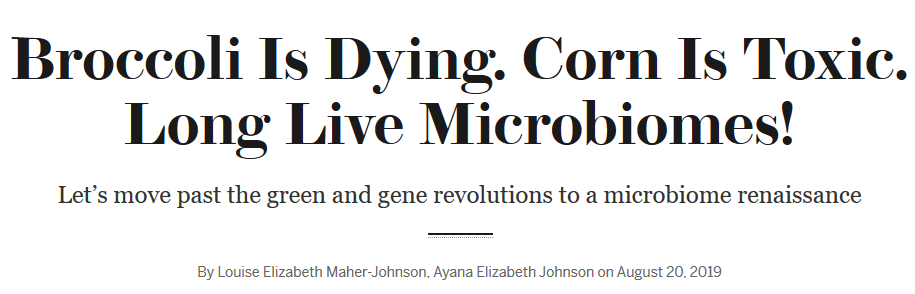
The article was given the ridiculous headline “Broccoli Is Dying. Corn Is Toxic. Long Live Microbiomes!” It was co-authored by a marine biologist and a retired English teacher. As one might expect from the headline, the article makes one outrageous, unscientific claim after another.

screenshot broccoli is dying corn is toxic long live microbiomes

The lies, distortions, and laugh-out-loud whoppers start early and often. Let’s dissect them:

As food writer Mark Bittman recently remarked, since food is defined as “a substance that provides nutrition and promotes growth” and poison is “a substance that promotes illness,” then “much of what is produced by industrial agriculture is, quite literally, not food but poison.”
This is the first sentence. Yes, that’s how this screed actually begins. Everything you eat is poison. How do we know? Because an organic food activist with no relevant scientific training or expertise says so..............To Read More.....

Related article:  How European-Based NGOs Block Crop Biotechnology Adoption In Africa, Margaret Karembu, Director of International Service for the Acquisition of Agri-biotech Applications, Africa regional office (ISAAA) AfriCenter based in Nairobi | February 23, 2017

Sunday, June 23, 2019

Science Saves an Old Chestnut

Genetic engineering rescues a tree from a threatening fungus.

By Hank Campbell 

A forest of chestnut trees ravaged by blight in Luray, Va. Photo: Library of Congress
 
A blight-tolerant American chestnut tree is the latest example of what the science community has begun to call a GRO—a genetically rescued organism. In the past century approximately four billion chestnut trees have been lost in the U.S. due to blight that spread when the Cryphonectria parasitica fungus arrived with chestnut trees imported from Asia. A once-dominant hardwood species is now rare.
Nature can be fickle, but using science to engineer solutions allows precise methods to combat natural pathogens. Some species are resistant to the fungus, and that’s why it makes sense to use transgenic tools to help the chestnut tree utilize beneficial genes from other plants—essentially vaccinating against the fungus.

It’s all part of a 28-year effort by the nonprofit American Chestnut Research and Restoration Project, led by the State University of New York’s College of Environmental Science and Forestry. Scientists use a gene from bread wheat that produces an enzyme called oxalate oxidase, which prevents the fungus from forming cankers on plant stems. The enzyme is found in all grain crops, plus bananas, strawberries and more..........To Read More.....

Sunday, April 7, 2019

Sidelined Because She Rejects Radical Green Agendas?

Paul Driessen Apr 06, 2019

 Aurelia Skipwith has a BS in biology from Howard University, a Master’s in molecular genetics from Purdue and a law degree from Kentucky. She has worked as a molecular analyst and sustainable agriculture partnership manager. She was also co-founder and general counsel for AVC Global, a Washington, D.C.-based agricultural supply chain development company that helps small farmers link up with multinational buyers and with agronomy, business, financial and other service providers.

For two years, she served as Deputy Assistant Secretary for the Interior Department, where she performed her duties so well that last October President Trump nominated her to become the next Director of the U.S. Fish & Wildlife Service (FWS) at Interior. She is an ideal candidate for the post.

She’s also only the third woman ever nominated for this position – and the first African American. Her impeccable scientific, legal, agricultural and conservationist background would ensure fairness, balance, integrity, solid science and multidisciplinary thinking in FWS decision making.

And yet, Ms. Skipwith lingers in confirmation limbo, along with hundreds of others whose nominations have been stalled for many months to well over a year. Too many Democratic senators appear determined to prevent the president from having people onboard who would implement his policies.

In fact, the US Senate has already been forced to hold cloture votes – ending drawn-out debates – on 128 Trump nominees! In glaring contrast, the Senate had a grand total of only 24 such cloture votes for all six previous presidents combined: Carter, Reagan, Bush, Clinton, Bush II and Obama! That’s 32 times more nominees by this president sidelined by Congress than during all ten previous presidential terms.
 
Why is Ms. Skipwith being treated this way? It appears to be simple ideological politics. Senate Democrats seem to be acquiescing to the demands of Deep Green environmentalists and Deep State career bureaucrats who do not like having their views and policies challenged.

Her molecular analysis and sustainable agriculture work were with Monsanto, the ultimate Evil Corporation to many of her opponents, because it manufactures both Roundup weedkiller and genetically engineered (GE) crops like Bt corn and Roundup-Ready soybeans. As Deputy Assistant Secretary, Ms. Skipwith supported reversing Obama era bans on planting such crops and using advanced-technology neonicotinoid pesticides in wildlife refuges administered by Fish & Wildlife.

The 2014 bans resulted from collusive sue-and-settle lawsuits between environmentalist groups and Obama DOI officials. They were reversed in August 2018, following a careful review process. As I have noted in many articles (here, here and here, for example), GE crops, glyphosate (the active ingredient in Roundup) and neonics are safe for humans and the environment. They also enable farmers to produce more food from less land, using less water and fewer pesticides, and with greater resistance to droughts, floods, insects and climate change, than is possible with conventional or organic crops.
 
Genetically engineered crops promote sustainable agriculture and help the world feed billions who otherwise face prolonged malnutrition and starvation. And yet, radical greens oppose them. They even attack Golden Rice, which prevents blindness and death in malnourished children and parents, by incorporating genes that produce Vitamin A precursors, vastly expanding nutritional values in rice.
Americans alone have consumed more than four trillion servings of foods with at least one GE ingredient – without a single documented example of harm to a person or the environment.

Regarding glyphosate, only one agency, the International Agency for Cancer Research (IARC), says the chemical is “probably carcinogenic” to humans – and its analysis is tainted by fraud and blatant conflicts of interest. Studies by the European Food Safety Authority, Food and Agriculture Organization, Germany’s Institute for Risk Assessment, Australia’s Pesticides and Veterinary Medicines Authority, and other respected organizations worldwide have concluded that glyphosate is safe and non-carcinogenic.
U.S. Environmental Protection Agency scientists conducted a “comprehensive systematic review of studies submitted to the agency and available in the open literature,” and concluded that the chemical “is not likely to be carcinogenic in humans.” Health Canada conducted a similarly extensive review of global studies, found no likely cancer risk, and noted that “no pesticide regulatory authority in the world” believes glyphosate is a cancer risk to humans “at the levels at which humans are currently exposed.”

As cancer researcher Arthur Lambert noted recently, “exposure to carcinogens influences the risk of developing cancer, which is a function of many factors, including the dose and duration of the exposure” – to glyphosate for example. But other factors also play integral roles, including inherited genes and genetic mutations, how well one’s immune system can find and eliminate mutated cells before they develop into cancer, personal lifestyle choices, and exposure to additional carcinogens over the years. Separating all those factors is virtually impossible.
 
Risks associated with glyphosate fall “somewhere between the small hazard that comes from eating a considerable amount of bacon (for colorectal cancer) and consuming very hot tea (for esophageal cancer),” Lambert notes. In fact, IARC lumps bacon, sunlight and plutonium together in its “definitely carcinogenic” category and lists as “possible” carcinogens pickled vegetables, caffeic acid found in many fruits and vegetables, and even drinking hot beverages or working the night shift.

If glyphosate poses few risks of cancer in humans, its threats to ducks, geese, turkeys and other animals in wildlife refuges are likely infinitesimal. The same is true for GE crops and neonicotinoid pesticides.

Most neonics are used as seed coatings, which get absorbed into plant tissues as crops grow. They protect plants against insect damage by targeting only pests that actually feed on the crops – and are largely gone by the time mature plants flower, which means they are barely detectable in pollen.

As to claims that neonics harm bees and thus should be banned from wildlife refuges, a 2015 international study of wild bees found that most wild bees never even come into contact with crops or the neonics that supposedly threaten them. The same study also determined that the 2% of wild bees that do visit crops – and so would be most exposed to these pesticides – are among the healthiest bee species on Earth.

The eight senators who recently expressed concern that chlorpyrifos and other pesticides threaten multiple protected species should applaud Interior’s reversal of bans on modern agricultural technologies (which reduce the use of such pesticides). Ducks Unlimited and the National Wild Turkey Federation certainly did.

The bans “were clearly not based on science,” they said, adding that the reversal restored GE crop use as an “essential tool” for waterfowl and wildlife management in national wildlife refuges. Many refuges were established along migratory bird flyways to provide food for waterfowl. But some can provide sufficient food only through cooperative agreements that let local farmers plant crops on refuge lands in exchange for leaving some of their crops unharvested, to supplement natural food on the refuge.

Genetically modified crops maximize crop yields, the FWS has explained, and “a blanket denial” of their use limits the latitude that refuge managers need to fulfill the purposes of each refuge. The ban on neonics was equally problematical because they are often used with GE crops and Roundup.

Aurelia Skipwith’s actions reflect the best in science-based government decision making. Her broad expertise enables her to separate fact from fiction, and reality from ideological agendas. She is the right person for this job – and indeed may turn out to be one of the best FWS directors ever. The Senate should confirm her forthwith.

Paul Driessen is senior policy advisor for the Committee For A Constructive Tomorrow (www.CFACT.org) and author of many articles on the environment. He has degrees in geology, ecology and environmental law.

Thursday, March 21, 2019

Pseudo-science alert: For $9,500, Politico provides disinformation about crop biotechnology, GMOs and pesticides

| | March 19, 2019

The Politico news website is known for its political coverage in the United States, posting stories on a wide range of topics, mostly cataloguing the infighting in the nation’s capital.

But more recently, the site strayed into territory outside of its comfort zone, into science and the controversial issue of agricultural biotechnology — GMOs and the pesticides used by farmers, organic and conventional — and its ideological naiveté and lack of science expertise showed through, much to the embarrassment of the political news site.

The site’s graphics editor, Patterson Clark, who has no background as a working scientist or journalist writing about crop biotechnology, produced an infographic that illustrated how food has been genetically modified by corporations, and purported to offer a “deep dive” into gene editing — for as much $9,500! But the information they offered was poorly sourced and inaccurate. And when given the chance to address the actual science behind the issue of breeding, they declined.

Here’s the story..........To Read More.....


Wednesday, August 8, 2018

Prominent anti-GMO NGOs and organic businesses partnered with Russia to ‘smear’ American agriculture

| | August 1, 2018 @ Genetic Literacy Project

It’s no secret that although the Internet has vastly improved our lives in many respects, it has downsides — less interpersonal interaction, more anonymous snarkiness, online harassment and even cyber-stalking.  But arguably worst of all is the amount of purposeful disinformation — fake news — that is promulgated by special interests.

Retired U.S. Army officer, author and former Fox News commentator Ralph Peters calls it “post-modern propaganda“:

No plague in history spread with the speed of internet disinformation.  We live in an age of hyper-charged propaganda, an onslaught of lies more pervasive than any that came before.  Over millennia, propaganda changed minds.  Today, it changes governments and subverts institutions.

[Editor’s note: This is the first of two articles examining links between Russian propaganda efforts and anti-GMO forces. Read part two.]

It’s difficult to stop or correct the promulgation of misinformation, especially when it’s a smear that’s part of a well-financed, highly-organized campaign.  Paid agents cleverly and relentlessly attack not so much the ideas but the people promoting them.

The successful smear is often based on some shred of truth, but these media- and Internet-driven “hit pieces” are designed to obscure the truth. The intricacies of this subject are nicely explicated by journalist Sharyl Attkisson in her book, “The Smear: How Shady Political Operatives and Fake News Control What You See, What You Think, and How You Vote.” 

Smears of American products and individuals via fake news are the stock in trade of propaganda organizations, usually domestic but increasingly foreign as well. Russia leads the pack.

Russia’s propaganda/disinformation campaigns

TV “news channel” RT (formerly Russia Today, which has its roots in Pravda), the Kremlin’s English-language propaganda arm, is the mouthpiece for Russia President Vladimir Putin’s agenda.
A report from the Office of the U.S. Director of National Intelligence (DNI) implicated RT in Russian hacking during the 2016 presidential election. It found that the network uses the internet and social media to conduct “strategic messaging for the Russian government” and that its programming aims “at undermining viewers’ trust of U.S. democratic procedures.”

Fake news about politics, and also about science and technology, is RT‘s trademark, as illustrated by its blatant disinformation attacks on the reporting of news by respected media outlets like the BBC.  And according to the DNI’s’ report, RT became a platform to push anti-fracking disinformation in order to damage the U.S. shale industry.

Opposition to genetic engineering

Genetic engineering in agriculture is a sector that holds intense interest for the Russians. Harkening back to the Lysenkoism catastrophe for agriculture in the Soviet Union, their expertise and current R&D in that area are virtually nil, and there is a ban on genetically engineered organisms from abroad entering the country, so they’ve adopted a strategy of trying to stymie its development elsewhere.

As Dr. Alex Berezow of the American Council on Science and Health pointed out: “RT has never been fond of GMOs (genetically modified organisms), which are largely the result of American innovation. In a 2015 article, RT reported on Russia’s decision to ban GMO food production in Russia. Tellingly, one of the protesters shown in the report is holding a sign that reads, ‘Goodbye America!’ The anti-GMO stance is not based on science or health concerns; instead, it’s based entirely on hurting U.S. agricultural companies.”

A Russia-centered group concocted the bizarre FactorGMO scam, which billed itself at its 2014 launch as “the world’s largest international study on GMO safety,” as though that issue was still in doubt.  The $25 million project has vanished into thin air.  And RT has just released (May 23) a “documentary” film, “The Peril on Your Plate,” a propagandistic screed that presents yet again all the anti-genetic engineering memes and fake news.

Stirring up trouble
 
None of this is surprising. As one of my colleagues, a prominent Russia expert, observed, “Whatever stirs up trouble in the U.S., Russia is ready to help make it worse.”

That brings us to the complementary, well-financed U.S.-based anti-genetic engineering movement, which provides numerous examples of collaboration with Russia on promulgation of fake-news stories and joint campaigns, as described here and here.  The Internet provides a loud and readily available echo chamber for propaganda and trolling.

This syllogism explains the motivation of all the bad actors, here and abroad, for wanting to discredit genetic engineering:
  • The United States is by far the world’s leader in both the development and cultivation of genetically engineered (GE) plants
  • Genetic engineering in agriculture is the most rapidly adopted agricultural technology in history
  • Organic agriculture strictly bans GE plants produced with the most precise and predictable molecular techniques
  • Recent advances in GE plants–higher yields, pest- and disease resistance, drought- and flood-tolerance, improvements in sustainability, traits with appeal to consumers, etc.–are making conventional (i.e., non-organic) agriculture ever-more efficient and superior to organic’s pathetic performance
  • Virtually no development or cultivation of genetically engineered plants takes place in Russia. So Russia seeks to prevent genetic engineering from expanding and succeeding elsewhere
Collusion between U.S. NGOs and Russia?

USRTK, the most aggressive of the anti-genetic engineering NGOs, admits to having received $529,500 since 2014 from the Organic Consumers Association, an advocacy group whose agenda includes a “global moratorium on genetically engineered foods and crops,” and which routinely promulgates fake news about the supposed hazards of genetic engineering.

And according to Dr. Berezow of the American Council on Science and Health, “Ronnie Cummins, the International Director of OCA, is known to propagandize for RT.”  (Cummins is a talking head for RT here and has attacked on those in the scientific community who defend advances in science and technology, including genetic engineering.)

Another six-figure supporter of USRTK is Dr. Bronner’s Family Foundation; Dr. Bronner’s is a large purveyor of various “natural” and organic products, including the “iconic soap of the countercultural 60’s.”

USRTK and RT have the same objective, Dr. Berezow suggests:  “USRTK and RT both share a common agenda: To undermine American science and technology for financial gain.  Gary [Ruskin, the co-founder and co-director of USRTK] gets more money from organic activists, and Russia worries less about competing against America’s multinational agriculture companies.  Everybody wins…except, well, Americans.”

There’s more direct evidence of a Russian connection to anti-genetic engineering trolling in the United States.  This story, which claims that Melania Trump has banned genetically engineered foods from the White House and favors organic products, ran on May 30, 2017, on Your News Wire, which is widely considered to be a fake news source linked to Russia.

The author of the article, “Baxter Dmitry,” has penned articles that allege that, among other things, “Sweden Bans Mandatory Vaccinations Over ‘Serious Health Concerns’,” (untrue) and the arrest for “treason” of a “former Hillary Clinton employee” (untrue).

Studies In bias

Much of the genetic engineering article, including some of the quotes attributed to the First Lady, are cribbed verbatim from a 2010 article in Yes! Magazine that had nothing whatever to do with her.
If the involvement of Russia and its notorious troll factories seems a stretch, consider the recent study by two Iowa State University researchers who looked at the source of articles containing the word “GMO” (genetically modified organism) and how genetic engineering was portrayed.  They found that the Russia’s English-language propaganda outlets RT and Sputnik produced more articles containing “GMO” than five other major news organizations — Huffington Post, Fox News, CNN, Breitbart News and MSNBC — combined.

The two Russian outlets accounted for more than half of all the GMO-related articles among the seven sites (RT, 34%; Sputnik, 19%).  “RT and Sputnik overwhelmingly portrayed genetic modification in a negative light,” the researchers wrote. “Among U.S. news organizations, the left-leaning Huffington Post produced the most ‘anti’ articles, followed by CNN. Fox News produced the most neutral or mixed coverage of GMOs.”

Also, they found that RT published “(N)early all articles in which the term GMO appeared as ‘click bait’.”

Pro-Russia activists responded with a bizarre interpretation: They implied that the Iowa State researchers were biased, and that the timing of the study’s release was somehow related to the Russian government’s review of the proposed Bayer-Monsanto merger.
Advocacy, which we see in many industries and special-interest groups, is one thing. But character assassination, trolling and intimidation are something else.  They cross the line. Part 2 will discuss that.

Henry I. Miller, a physician and molecular biologist, is the Robert Wesson Fellow in Scientific Philosophy and Public Policy at Stanford University’s Hoover Institution and a former trustee of the American Council on Science and Health. He was the founding director of the Office of Biotechnology at the FDA. Follow him on Twitter @henryimiller 

This article was originally published at Investor’s Business Daily as “Russia Does Far Worse Than Meddle In Our Elections — It Meddles In Our Science” and has been republished here with permission. 

Friday, July 27, 2018

CRISPR-Created Foods are Different than GMOs. It's Wrong for Anti-GMO Activists to Pretend They're Not.

By Chuck Dinerstein — April 3, 2018

Monsanto, perhaps to rebrand itself, and certainly to remain a leader in agricultural biotech has helped establish and fund Pairwise Plants a start-up using CRISPR-Cas9 technologies to modify seeds. They have given the new company money and their vice-president of global biotechnology to head the start-up, so this is a strategic business move not simply hedging their bets. This is important because CRISPR-Cas9 may genetically modify a crop, but it doesn’t necessarily result in a genetically modified organism, the dreaded GMO. To understand how that can be, we need to understand both genetic modification and federal regulations.

Mutagenesis...........To Read More....

Wednesday, July 25, 2018

Did anti-GMO groups plant ‘rogue’ GMO wheat in Canada to deliberately disrupt markets to manipulate public opinion?

, | | July 20, 2018

In the summer of 2017, a contractor applied the popular weed-killer glyphosate (brand name Roundup®) to clear some weeds along an oil and gas service road. (Glyphosate is a very effective herbicide that controls hundreds of different weeds.) When wheat plants did not die after the contractor applied the herbicide, he contacted the authorities. 

The Alberta government determined the wheat was an herbicide-tolerant variety that had been genetically engineered (GE) with molecular techniques. GE wheat had been field-tested (not in recent years, however), but no developer has ever applied for or received regulatory approval for cultivation or sale of a GE wheat variety in Canada or the United States. 

Detailed investigation by the Canadian Food Inspection Agency (CFIA) uncovered some very strange facts. The GE wheat found in Alberta contained the same herbicide-tolerance (HT) gene (designated MON71200) that was field tested by the Monsanto Company (now Bayer) between 1998 and 2000, but those field trials were no closer than 180 miles from where the sample was found. 

Most puzzling to the investigators, however, was that the genetics of the newly found wheat plant itself not only didn’t match any of the approximately 450 registered varieties of wheat allowed to be grown in Canada, but it didn’t match any wheat plant anywhere of which the Canadian authorities were aware. 

Could the newly discovered GE wheat have escaped from a field trial and survived for nearly two decades? The findings of the CFIA don’t support that thesis.........To Read More....

Tuesday, July 24, 2018

Risk, Hazard and the Precautionary Principle: Why Europe Gets Crop Biotechnology and Chemical Regulation So Wrong

David Zaruk, Founder of GreenFacts, Environmental-Health Risk Governance Analyst, Professor at Odisee University College

This is the first article in a three-part series on risk and hazard:
  • Part I: Risk, Hazard and the Precautionary Principle: Why Europe Gets Crop Biotechnology and Chemical Regulation So Wrong
  • Part II: Precautionary Politics: Europe Moves Backward into a Fear-Based ‘Dark Ages’ in Regulating Agriculture and Cancer Risks
  • Part III: In the Battle to Regulate GMOS, Gene Editing and Other New Breeding Techniques, Who Has ‘Hazard Blood’ on Their Hands?
Why is Europe seemingly so confused when it comes to understanding the differences between chemicals and technologies posing manageable hazards versus those that threaten us with unacceptable risks? It’s a conundrum that perhaps only a child can fully appreciate.

I was recently discussing the concept of safety, dangers and risks with a seven-year-old boy who wanted to cross the street to join his friends in a playground.

“Cars can be dangerous,” I advised him. “Please stay away from the streets when playing.”
It seemed like common sense advice. A hazard (like a car) is only a risk if we are involved in a crash or it hits us while moving..........To Read More....

My Take - I look forward to the rest of David Zaruk's series because it's apparent far too many suffer from what John Adams, professor of risk at University College London, calls "the modern disease of compulsive risk assessment psychosis - otherwise known as crap.” 

Wednesday, February 21, 2018

Naturopathic Cult Populism

on

This is Part 2 of the Insignificant Trilogy.

We are witnessing a rapid rise in naturopathic populism.
  • Up to two thirds of Americans are using non-conventional methods to treat cancer. Naturopathic doctors (see an excellent overview) wear white coats, work in clinics and deceptively offer a simple, painless, ineffective alternative to modern medicine.
  • Four in ten in France do not believe vaccines are safe (there is presently a deadly measles epidemic in one French region) and vaccine safety has become an election issue in Italy. Measles cases are up 300% with 20,000 victims last year.
  • Sales in organic food, unregulated supplements and bogus detox programmes have been rising exponentially. These marketing opportunists have attracted the big food manufacturers and brands to move into the organic food space to cash in on financial margins built on fear and lies.
  • It is almost impossible to find a policymaker today in Europe who will stand up and publicly support agricultural technologies (pesticides, fertilisers, plant breeding).
Over the last decade, there has been a concerted attack on scientific expertise, authorities and conventional practices by a coalition of gurus, anti-industry campaigners, interest groups and environmental NGOs. Naturopaths (defined broadly as those blindly favouring natural methods, substances and treatments over conventional scientific ones) operate across a wide range of disciplines from homeopathy, alternative medicine, organic food and supplements, utilising a network of retailers, producers, lobbyists and media actors.

They are zealots (eco-religious fundamentalists) putting forward a naturopathic populism based on fear campaigns, simplistic alternatives and outright lies. Anti-vaxx, anti-chemicals, anti-pharma, anti-industry, anti-trade, anti-science … these agitators have done well by fostering doubts and distrust of experts and regulators while raising an heroic profile of the brave naturopathic guru leading individuals who resists the status quo. This blog will consider how their techniques fit within a populist cult playbook.......To Read More....

Gene-editing advances put us at the dawn of a revolution in medicine

| | February 7, 2018


Genetic engineering is most often linked to the foods that we eat and crops that we grow.  It’s a technology that has generated a great deal of controversy, with opponents claiming it is inherently dangerous to human health and the environment.  There is however no scientific evidence to validate those concerns.

GE foods have been exhaustively tested and researched with more than 2,000 studies vouching for their safety. All the major National Academy of Sciences in the world have concluded that they are no more dangerous than conventionally and organically grown crops. Not one incident of harm or allergic reaction has been traced to the consumption of GE foods.

What’s not widely known is that genetic engineering plays a critical role in the development and production of drugs that improve the quality of life for people with chronic diseases. For instance, virtually all of the insulin produced for diabetics is made through a process that involves genetic engineering.  Treatments for infertility, hemophilia, blood clotting and dwarfism also depend heavily on genetic engineering as does immunotherapy for developing treatments for cancer....To Read More...

‘Social Justice Warrior’ Vandana Shiva Is A Poor Advocate for the Poor

The recently-published “Social Justice Warrior Handbook,” which satirizes people who promote liberal, multicultural, anti-capitalist, anti-globalization, politically correct views, could have had Indian activist and mountebank Vandana Shiva on the cover. 

She opposes the tools and practices of modern agriculture and science--and well, modernity in general—and advocates retrogressive policies that will cause widespread malnourishment, deprivation and death to the very people she claims to champion.  And she’s no friend of the environment, either.
 
Illustrating the quest for “Back to Natutre” and anti-globalization fervor that has infected many U.S. universities, Shiva has been a popular guest lecturer at American universities.  In recent years, she has been invited to a number of U.S. campuses, including Beloit College, the College of New Jersey, Arizona State, the University of Utah and Wake Forest and Georgia Southern Universities, among others.  Although she gets good press from left-wing and environmental publications, and naïve undergraduates dote on her, Shiva is widely considered by the scientific community to be abjectly unbalanced (in both senses of the word) for advocating unsound policies and promulgating disproven theories about agriculture.

As science writer Jon Entine and Monsanto science communicator Dr. Cami Ryan discussed in a Forbes article, many of Shiva’s hobby horses have proven to be exceedingly lame.  Some prominent examples:
  • The “Green Revolution.”  The new varieties and practices of the Green Revolution provided greater food security to hundreds of millions of people in developing countries on much of the planet; it made available high-yielding varieties of wheat and also new agronomic and management practices that transformed the ability of Mexico, India, Pakistan, China, and parts of South America to feed their populations.  From 1950 to 1992, the world’s grain output rose from 692 million tons produced on 1.70 billion acres of cropland to 1.9 billion tons on 1.73 billion acres of cropland—an extraordinary increase in yield per acre of more than 150 percent.  India is an excellent case in point.  In 1963, wheat grew there in sparse, irregular strands, was harvested by hand, and was susceptible to rust disease.  The maximum yield was 800 lb per acre.  By 1968, the wheat grew densely packed, was resistant to rust, and the maximum yield had risen to 6000 lb per acre.  Without high-yield agriculture, either millions would have starved or increases in food output would have been realized only through drastic expansion of land under cultivation—with losses of pristine wilderness far greater than all the losses to urban, suburban and commercial expansion.
And yet, from her perch in a parallel universe, Shiva contends that the Green Revolution actually caused hunger.  Here, as elsewhere, she employs the propaganda technique known as the Big Lie, a phrase coined by Adolf Hitler in his 1925 book Mein Kampf.  Shiva promulgates lies so "colossal" (as Hitler put it) that it seems inconceivable that someone could "have the impudence to distort the truth so infamously.”  Read on.
  • Golden Rice, genetically engineered varieties that are biofortified, or enriched, by genes that produce beta-carotene, the precursor of vitamin A.  These could be a monumental public health breakthrough, because vitamin A deficiency is epidemic among poor people whose diet is composed largely of rice, which contains no beta-carotene or vitamin A.  In developing countries, 200 million-300 million children of preschool age are at risk of vitamin A deficiency, which increases their susceptibility to illnesses including measles and diarrheal diseases.  Every year, about half a million children become blind as a result of vitamin A deficiency and 70% of those die within a year.  But Shiva is opposed to it: “By focusing on only one crop, rice, which by itself does not provide all the nutrients, including higher quantities of Vitamin A than Golden Rice, the Golden Rice pushers are in fact worsening the crisis of hunger and malnutrition.”  “Promoters of Golden Rice are blind to diversity, and hence are promoters of blindness, both metaphorically and nutritionally,” she adds.  Shiva has dismissed Golden Rice as a hoax and a myth–which are the vilest sort of lies, not unlike those of the pernicious charlatans who condemn childhood vaccination for the prevention of infectious diseases. 
As Entine and Ryan wrote: “Shiva’s alternate proposed solution for promoting a ‘diversity of diet’ has not worked for the very poor who cannot afford to buy vegetables or fruits, or cannot devote the land on their subsistence farm to grow more of them.”  The hoax is Shiva’s unworkable alternative, not the proven capabilities of genetic engineering.
  • Genetically engineered, pest-resistant cotton (Bt-cotton, so-called because it contains a protein from the bacterium Bacillus thuringiensis that kills certain insects).  Shiva claims that the cultivation of these seeds is not only ineffective but actually causes hundreds of thousands of farmer suicides in India.  But Shiva’s statistics are cherry-picked, largely irrelevant and often simply wrong, and her argument relies on a fallacy of logic known as post hoc, ergo propter hoc–after the fact, therefore because of the fact.  In other words, she confuses correlation with causation, the kind of “logic” that leads one to believe that autism is caused by organic food because of graphs like this one. 
In a 2013 article in the journal Nature, agricultural socio-economist Dominic Glover observed, “It is nonsense to attribute farmer suicides solely to Bt cotton,” and moreover, “Although financial hardship is a driving factor in suicide among Indian farmers, there has been essentially no change in the suicide rate for farmers since the introduction of Bt cotton.”

Reinforcing Glover’s observations, a definitive, comprehensive study of Bt-cotton in India published in 2011 concluded: “Bt cotton is accused of being responsible for an increase of farmer suicides in India. . . Available data show no evidence of a ‘resurgence’ of farmer suicides.  Moreover, Bt cotton technology has been very effective overall in India.  Nevertheless, in specific districts and years, Bt cotton may have indirectly contributed to farmer indebtedness, leading to suicides, but its failure was mainly the result of the context or environment in which it was planted.”  A 2006 study of four of India’s major cotton-producing states found that Bt-cotton gave rise to yield gains of approximately 31% and a 39% decrease in number of insecticide sprays, which led to an 88% increase in profitability, equivalent to about $250 per hectare.

Eminent UC Berkeley agricultural economist David Zilberman echoes those findings and sums up India’s experience with genetic engineering this way: “India gained from adopting [genetic engineering applied to] cotton but has lost from not adopting it with other crops.  The US, Brazil and Argentina adopted [genetic engineering] in corn and soybean, which led to increases in output and gains from exporting these extra crops. India and the rest of the world have also indirectly enjoyed benefits from the increased global supply of corn because of [genetic engineering].

In a 2014 article, “Seeds of Doubt,” in The New Yorker, investigative journalist Michael Specter called into question a number of Shiva's claims regarding genetic engineering, as well as her ethics and judgment:

At times, Shiva’s absolutism about [genetic engineering] can lead her in strange directions.  In 1999, ten thousand people were killed and millions were left homeless when a cyclone hit India’s eastern coastal state of Orissa.  When the U.S. government dispatched grain and soy to help feed the desperate victims, Shiva held a news conference in New Delhi and said that the donation was proof that “the United States has been using the Orissa victims as guinea pigs” for genetically engineered products.  She also wrote to the international relief agency Oxfam to say that she hoped it wasn’t planning to send genetically modified foods to feed the starving survivors.  When neither the U.S. nor Oxfam altered its plans, she condemned the Indian government for accepting the provisions.

We endorse shopping in the marketplace of ideas, but not when toxic goods there pollute it.  Recall Daniel Patrick Moynihan’s observation that everyone is entitled to his own opinion but not his own facts.  Shiva is a seemingly endless font of bogus, made-up facts–that is to say, lies--and bizarre reasoning.

Even the way Shiva represents herself to the public at large and to potential speaking venues–variously as a “scientist,” “nuclear physicist,” or “quantum physicist--is untrue.  However, she earned her doctorate not in physics, but in philosophy.

Ironically, Shiva’s connection with physics illustrates not her expertise in the discipline, but her wrong-headedness. Her dissertation in the philosophy of science at the University of Western Ontario focused on the debate over a central notion in physics known as Bell’s Theorem, which is concerned with “testing whether or not particles connected through quantum entanglement communicate information faster than the speed of light,” and which has been called the “most profound theory in science.”  The abstract of Shiva’s dissertation states, in part: “It has been taken for granted that Bell’s [theorem] is based on a locality condition which is physically motivated, and thus his proof therefore falls into a class by itself.  We show that both the above claims are mistaken” (emphasis added).

But contrary to Shiva’s conclusion, Bell’s theorem has been proven scientifically correct.  As Entine and Ryan wrote, “The main thesis of quantum mechanics that she challenged has since been confirmed by experimental physics, meaning that her thesis stands at odds with factual reality.”  But reality testing has never been Shiva’s forte.

The New Yorker’s Michael Specter wrote that Shiva has been called the “Gandhi of grain” and been “compared to Mother Teresa.”  We think a more apt comparison would be to Trofim Denisovich Lysenko, the charlatan and ideologue who single-handedly laid waste to Soviet agriculture during the Stalin era and for years thereafter.

While this upper-caste Indian gets little right about science, she is adept at extracting money from sponsors on the lecture circuit.  According to her speakers’ agency, the Evil Twin Booking Agency (we did not make up that name), Shiva’s usual fee for an American university appearance is $40,000 plus a business class round-trip ticket from New Delhi.  We can infer, then, that American universities probably pay Shiva around $50,000 for each appearance, at which she exposes their students to her mendacious, baseless attacks on modern agriculture and science.

As for the actual substance of Shiva’s presentations at universities, we can only imagine…  After all, she is the author of “In Praise of Cowdung” – a paean to peasant agriculture and an attack on improved seeds and modern fertilizers in Indian agriculture.  That essay in particular reminds us of an old “Peanuts” cartoon in which the character Lucy van Pelt is about to embark on a writing assignment.  “Write about something you know well,” the teacher instructs.  Lucy begins typing, “The air hung heavy with stupidity…”

Henry I. Miller, a physician and molecular biologist, is the Robert Wesson Fellow in Scientific Philosophy and Public Policy at Stanford University’s Hoover Institution and a former trustee of the American Council on Science and Health. He was the founding director of the Office of Biotechnology at the FDA.  Drew L. Kershen is the Earl Sneed Centennial Professor of Law (Emeritus), University of Oklahoma College of Law, in Norman, Okla. This article first appeared in the American Council on Science and Health print magazine Priorities.