Search This Blog

De Omnibus Dubitandum - Lux Veritas

Showing posts with label EU. Show all posts

Tuesday, May 27, 2025

Points to Ponder

By Rich Kozlovich

How did Hamas get control of Gaza?  In 2005, Prime Minister Ariel Sharon, who was Israel's Prime Minister then, embraced leftist dogma about getting along with Muslims, which has failed over and over again, but he thought it would be a great idea to just give Gaza over to the Muslims and even provide necessary services for them they could not and would not provide for themselves, that way Muslims wouldn't hate Israel, and the world praised him.

It's clear the man either never read a history book or didn't believe history mattered.  Well, it does.  Hamas was an Islamic genocidal movement, it has always been such, and the people of Gaza like their genocidal insanity as they demonstrated by dancing through the streets as the coffins of innocent children who were hostages of Hamas were paraded before them.

Giving Muslims Gaza and the West Bank was in effect a practical application of the Two State solution. It was stupid then, it’s stupid now, and will always be stupid. Israel should take the example of Jordan and other Arab states who kick all the “Palestinians’ out, and tell the UN, the EU nitwits, American leftists, Jewish leftists, in and out of Israel, and the rest of the world to shove it.

After the Reconquista of Spain the first ones they kicked out were the Jews. Sephardic Jews who were well assimilated, but they thought the Muslims would adjust and all would be just fine and dandy. They were wrong, and had to kick all the Muslims out of Spain. They were Muslims and Muslims will always be Muslims, and assimilation isn’t an Islamic concept, domination however is.

Now Spain seems to have forgotten their history and are allowing Muslims to pour in, almost uncontrolled, and guess what, they’re acting like …. Muslims …… as Muslims have acted for almost 1500 years.

As for these EU nitwits, Does the European Union actually think radical Muslims will reform themselves?  Which means rejecting the foundational philosophy if Islam, jihad.  It they do that, they're not Muslims, they're heretics, and the Koran demands death to heretics.  If the EU wishes to commit suicide, well, I really don’t care since Europe is a spent force, and the EU is doomed anyway, but they need to stop demanding Israel commit suicide.

Definition leads to clarity, and it boggles my mind how people play with words to alter reality. I've read recently how Trump's cabinet needs to stand up to Trump, as it's an advisory board to the President.  Let's try and get this right once... just once.. please.  While cabinet member may make suggestions and give advice, their job as cabinet members isn’t to be an advisory board, it’s a management team whose job is to salute, say yes sir, and carry out the instructions of the President of the United States. If they can’t live with that, then they need to find other employment.  

I keep reading about this new Golden Age that's coming as a result of tariffs and trade agreements, all of which I think are necessary, and beneficial to America, but there will be no golden age. I've read three books on historical cycles, all hard drudging, since they all have their own terminologies and time frames.  If there ever was a subject that needs a formalized academic disciple, that's it.

But the one thing all the books dealing with historical cycles agree on is we’re in an end cycle, which entails huge economic downturns, and violence. Unlike many of the world’s nations America will survive intact for six reasons. We can feed ourselves, fuel ourselves, arm ourselves, defend ourselves, create our own internal market, and pay off our national debt.

The rest of the world cannot meet all of those six basic necessities to remain stable.  They're taxing, spending, over regulation, national debt, and immigration will kill Europe.  As this end cycle progresses there will be a lot of restructuring before the beginning of a new historical cycle, but Europe as we know it will no longer exist, and who knows what direction that will take.

The world's leaders are divided into two groups. The Winston Churchill’s, and the Neville Chamberlain’s. Everyone loves the Chamberlain’s, they go along to get along guys, and everyone hates the Churchill’s, who just can’t seem to get along.At least until the go along to get along crowd’s failure to deal with what’s going wrong hits the fan. 

Then, all of a sudden, they discover they need a Winston Churchill to be the answer, and they hate it, and they hate him.   And no matter how successful a Churchill may be, they just can’t stop shooting arrows at the Churchill’s, which in America's case right now involves Donald Trump and Elon Musk. 

Why?  

Neither Trump or Musk is one of them, and the only thing they excel at is criticism, not problem solving. Adam Schiff epitomizes that quality. Go along to get along elitism is a human physiological disorder that’s plagued humanity throughout history, and it’s always going to be with us. Most leaders aren’t leaders, they’re managers who organize the direction everyone wants to go, no matter how foolish that may be. 

A leader stands up and says…. You’re all wrong, and I’m gonna tell you why! And if or when that person gets a leadership role, they act accordingly. If they’re successful, they’re hated all the more. No matter what you may read, that explains everything. How insane is that?

Thursday, March 21, 2019

Pseudo-science alert: For $9,500, Politico provides disinformation about crop biotechnology, GMOs and pesticides

| | March 19, 2019

The Politico news website is known for its political coverage in the United States, posting stories on a wide range of topics, mostly cataloguing the infighting in the nation’s capital.

But more recently, the site strayed into territory outside of its comfort zone, into science and the controversial issue of agricultural biotechnology — GMOs and the pesticides used by farmers, organic and conventional — and its ideological naiveté and lack of science expertise showed through, much to the embarrassment of the political news site.

The site’s graphics editor, Patterson Clark, who has no background as a working scientist or journalist writing about crop biotechnology, produced an infographic that illustrated how food has been genetically modified by corporations, and purported to offer a “deep dive” into gene editing — for as much $9,500! But the information they offered was poorly sourced and inaccurate. And when given the chance to address the actual science behind the issue of breeding, they declined.

Here’s the story..........To Read More.....


Friday, March 15, 2019

Viewpoint: Farmers’ crops are failing, and Europe’s precautionary assault on neonicotinoid insecticides is to blame

| | March 8, 2019

As the present leaderless European Commission limps to its pathetic end, Europeans will want to forget its five year string of failures and missteps across a wide range of issues. One section of the European population who will never forget the last five years of incompetence will be farmers, who have suffered from an endless stream of cowardly precautionary fixes that went against scientific evidence, political compromises that played into interest groups over agriculture and the rising influence of the organic food lobby and neo-Marxist greens hell-bent on furthering a confused, medieval perception of the countryside.

Yes, The Risk-Monger is angry. Farmers’ crops are failing at an alarming rate and someone should inform these proud precautionistas in Brussels that it’s their bloody fault.

A litany of failure..........To Read More....

Monday, December 24, 2018

Examining the EU’s contradictory treatment of glyphosate and copper sulfate pesticides

| | December 19, 2018

The politics of the European Union have often left observers baffled. But the decisions—and lack thereof—over how to regulate two popular pesticides have culminated in a series of contortions as member countries, courts and the European Parliament try to combine a strict precautionary principle, support of organic agriculture, and science.

The last category usually has received the shortest shrift.

For both the herbicide glyphosate and the fungicide copper sulfate, the EU granted a five-year license. But there the similarity of how Europe handled them ends.........To Read More.....

My Take - This is what happens with philosophy and reality collide.  We need to get this.  Organic agriculture has never been about health, hazards, risk, science or production.  It has always been about forcing people to live in a way that's approved by a bunch of irrational, misanthropic and morally defective misfits.  Well, time is always on the side of truth, because truth will very patiently wait for us. 

Sunday, June 4, 2017

European Commission: Scientists find neonicotinoids don’t harm bees, restrictions hurt farmers—but support permanent ban

|

Every time I think the European Union’s regulatory bureaucrats have bottomed out on substance and integrity, they find a way to sink even lower.

In February, I wrote about how the European Union has rigged the evaluation of whether state-of-the-art neonicotinoid pesticides (“neonics”) are “bee-safe” by using a “Bee Guidance Review Document” whose test conditions were made deliberately impossible to satisfy. (For those of you just tuning in, neonics, introduced in the 1990’s, are currently the most widely used class of pesticides. Mainly applied as seed coatings to crops, they are taken up into the plant and selectively control only the pests that actually damage or destroy crops while minimizing exposure to humans, animals and beneficial insects—including bees.)

Since then, however, the stakes in the EU crop protection drama have only increased. The pressure from activists has intensified–as have the EU’s manipulative and dishonest regulatory machinations. (How appropriate that Machiavelli was from an EU country.)........Then, in a striking bit of Orwellian newspeak, EU health and food safety Commissioner Andriukaitis claimed that the 2013 ban was “at no time based on a direct link on bee mortality.” Rather, he explained, the ban was instituted simply because the “approval criteria were no longer satisfied”–criteria derived from the rigged, unapproved “Bee Guidance Document” mentioned above. This is the sort of bureaucratic doubletalk that has caused EU regulators to be so despised............To Read More....

My Take - It might be interesting to compare the despicable actions of EU bureaucrats and the EPA.  In 2005 the American Council on Science and Health petitioned the EPA under the Information Quality Act, which required agencies to base their regulations on the best information available, to stop declaring products carcinogenic based on rodent testing alone as that was not the best information available for that purpose. 

Months later - after giving themselves numerous extentions - the EPA responded saying these declaration didn't fall under the auspices of the IQA because they weren't based on science but EPA policy.  So the question everyone should be asking is this - if their policies aren't based on science - what's are they based on.

The EU is going to collapse and the EPA needs to be dismantled

Friday, March 3, 2017

Bias at The New York Times? ‘The Truth is Hard’ when reporting on bees and neonicotinoid pesticides

|
The line between deliberately manipulating a story and poorly reporting the facts is perilously thin.

At Sunday’s Oscars, the United States’ ‘paper of record’ launched an advertising blitz positioning itself as the highbrow ethical responder to the spate of so-called ‘fake news.’ “The truth is hard…to find…to know,” the add, widely circulated on YouTube, proclaimed, somberly.

It’s a powerful message, one that the public and the media should reflect upon—including the leadership at the Times

itself. Whether a journalist presents a story in good faith but wrongly can be a matter of healthy debate. But increasingly, a more troubling ethical line is being crossed: some writers choose to arrange facts, or even invent them, in ways that grey out nuances to advance a storyline arrived at before independent reporting even commences.


That leaves the editor as the public’s final integrity life-line. But to fulfill their responsibility, editors need to be aware of their own biases, or they risk crossing over from being guardians of the truth to creators of biased or even fake news.

Which brings us to the New York Times’ coverage of food and farming issues, most recently its coverage of what has come to be known in recent years as “beemageddon”— concerns about the health of one of nature’s most important pollinators, the bee.

Are bees facing extinction as many environmental advocacy groups and some scientists claim; and are neonicotinoid pesticides the key reason behind their health problems, as many activists, and the Times, suggest?

Times’ Michael Pollan on presenting only one side of complex issues

Covering food and modern farming has not been the Times strong point. Journalist and foodie MIchael Pollan’s articles on the virtues of organic food and the dangers of ‘industrialized agriculture’ have been a Times’ staple since the early 2000s. In 2013, he bragged in a video interview with a fellow activist that he long has exploited the willingness of his editors to forego traditional vetting because they share his reflexive anti-industry perspective. View the video here:


[From the video]:
The media has really been on our side for the most part. I know this from writing for the New York Times…. [W]hen I wrote about food I never had to give equal time to the other side. I could say whatever I thought and offer my own conclusions. Say you should buy grass fed beef and organic is better, and these editors in New York didn’t realize there is anyone who disagrees with that point of view. So, I felt like I got a free ride for a long time.
It’s startling that a reputable journalist would boast about manipulating editors who shared a reflexively and uncritical anti-industry—and in this case, an anti-science—worldview. Pollan went on to bemoan that because of pushback from the science community, he now finds it increasingly difficult to present only his biased side of the story:
There is something called the Food Dialogues presented in various places to talk about how food is produced and greater transparency. … So, I think they have kind of spooked the newspapers into realizing they need to give equal time on this issue and it is an issue with two sides.
NY Times frames simplistic narrative on bee health controversy

Two recent Times articles on the swirling farm controversy about bee health and food—one two years ago and another last week—raise serious questions about whether the paper’s editors are still wearing ideological blinders on stories involving ‘villainous’ agri-businesses.


In 1994, the Times wrote an editorial about “The Bee Crisis,” in which it noted an alarming 50% crash in feral bees in New York state. It blamed that primarily on pesticides. The next year, the phase out began of the most common pesticides—pyrethroids and organophosphates—used to protect crops pollinated by bees. While effective, these chemicals were known to kill beneficial insects and pose serious human health hazards.

They were replaced by what then and now were considered by most entomologists to be a far safer alternative—neonicotinoids, a class of insecticides whose introduction in the mid-1990s coincided with a stabilization of the global bee population. While sometimes sprayed for particular fruit, vegetable or landscape applications, the most overwhelmingly prevalent use of neonics is as a coating for seeds, which then grow into plants that systemically fight pests.

The bee health and pesticide issue faded from the headlines until the winter of 2006-2007, when some US beekeepers began discovering that many of their bees had mysteriously abandoned their colonies. The bees left behind the queen bee, attended by too few, immature worker bees to sustain the colony, yet with ample viable brood and stored food. This was dubbed Colony Collapse Disorder (CCD).

CCD is a periodic but still inexplicable ecological phenomenon that’s been around since at least the 1800s, predating the modern, post-World War II use of synthetic pesticides, says University of Maryland entomologist Dennis vanEngelsdorp, who along with agricultural department researcher Jeff Pettis coined the term a decade ago. vanEngelsdorp, now head of the Bee Informed Partnership, has told me and other reporters, repeatedly, that there have been no instances of CCD over the past five years except cases linked to the Nosema fungus.

Times’ Michael Wines misframes the ‘neonic’ crisis?

But you wouldn’t know that if you depend on the Times as your paper of record. Since 2013, Michael Wines has reported on rising concerns about ongoing bee health issues–an issue he had been highlighting in increasingly alarming opinion-filled stories. His theme, hammered home in numerous reports, such as this article in 2015, fingered one culprit above all others: pesticides, particularly neonics. In what amounts to an editorial, Wines headlined the story: “Research Suggests Pesticide Is Alluring and Harmful to Bees.” His sources beyond two highly contested studies?–unidentified “other experts,” whose views stood in contrast to industry scientists and the overwhelming majority of mainstream entomologists who see the issue as complex, with pesticides playing a real but relatively minor role in bee health issues.

Researchers from Oregon State University
testing bees last August for the effects of pesticides.
 via NYTimes
Wines was back at it again later in 2015 after a temporary increase in over summer honey bee deaths. In this story, he incorrectly wrote that they were an extension of the long-since passed CCD phenomenon. He compounded this misreporting by playing up what has become known as the beepocalypse myth thesis, writing in Wines-like fashion that “some experts have focused on neonicotinoids” as the driving culprit.

So, who were these mysterious “experts” who appear like clockwork in his pieces that Wines claimed pointed to neonics as the Darth Vader of the bee world? Wines again never tells us.

That’s particularly odd, because he appears not to have consulted the primary source for the rest of his story, Dennis vanEngelsdorp.

If he had, he would have found that the University of Maryland entomologist doesn’t believe neonics are driving current bee health problems. They are way down the list of likely causes, he’s said, with number one being the Varroa mites that feed on the bodily fluids of

 bees. Varroa mites first surfaced as a problem in the US in the 1980s and began infesting beehives in California in 1993
. That crisis stabilized after the introduction of neonics later in the 1990s, then spiked with CCD, with sporadic problems since.
On average, about 10 to 15 percent of honey bees die each winter. In recent years, that percentage jumped to as high as 35 percent before dropping down to levels in the low 20s. There was a more recent rise in bee deaths during the summer, normally a period of hive replenishment, that has everyone spooked. Highly charged words like “beepocalypse” or “beemageddon” are now everywhere on the Internet. But what was causing the die-offs?

Like the fictional parents in the edgy comedy show South Park who blame Canada for all their woes, activists often coalesce around an issue and then come up with a simple and usually simplistic narrative to frame it. Strident opponents of modern agricultural technology initially blamed GMOs for bee deaths, and some still make that claim, although there is zero evidence to back it up. When that meme didn’t get traction, their campaign focus switched to neonics.

But mainstream entomologists never saw it that way. Noting the complexity of the emerging controversy, the US Department of Agriculture and the Environmental Protection Agency have taken a cautious, science-based approach, producing a broad-based assessment of the evidence. The independent researchers concluded that bees are facing unique stressors but neonics, and pesticides in general, were unlikely to be the major drivers of bee deaths.

Along with Varroa, the blue ribbon panel pointed to Nosema, a common parasite that invades their intestinal tracts and the use and perhaps misuse of miticides to control them; climate change; lack of genetic diversity in the bee population; loss of habitat; and an often-unmentioned factor that many entomologists believe may be the key factor—the stress put on bees by large commercial beekeepers, particularly to service the agri-business demand for bees needed for the California almond crop in late winter before bees normally repopulate.

Times’ Stephanie Strom: Bee health perpetrator profiled as victim?

While Wines never named the “some experts” who support the claim that neonics are at the center of the bee health issue, fellow Times reporter Stephanie Strom found two with that view. Her front business page story, “A Bee Mogul Confronts the Crisis in His Field,” on February 19, sympathetically profiled two of the country’s largest industrial bee moguls, Bret and Kelvin Adee.

Like the Wines’ story, Strom’s article shows no signs of conscious bias. I’ve long been a fan of both of their journalism, and I know Strom, who I’ve talked to on multiple occasions, is dedicated to reporting on complex issues fairly. But she botched this story. Most notably, the piece is infused with the popular activist-driven belief, rejected as simplistic by top entomologists, that neonics is the common thread linking the 2006-2007 CCD crisis to current bee health issues.

Strom cites the European Commission’s 2013 decision to ban neonics, and tees up Bret Adee to defend it:

“The more you study it, the more obvious it becomes: the relationship between the pesticides that have been sprayed everywhere over the last 10 years and what’s happening to bees,” she quotes Adee as saying.

Strom doesn’t mention that the ban was passed over the objections of many scientists. It’s led to new costs and pest pressures; a sharp increase in the use of the dangerous chemicals, pyrethroids and organophosphates, phased out years ago, and lower farm yields. She neglects to mention that European courts have issued rulings challenging the science behind the ban, and moves are underway to overturn it. 

Here is the Orwellian twist: Large-scale beekeepers like the Adees who see their pollinator hordes as traveling livestock, and are widely viewed by entomologists as a key driver of bee health problems, are now profiled by the New York Times as a credible source for diagnosing bee health—and as victims?

Strom sees no irony in this. And she apparently does not know enough about how pesticides are used to pick up on the fact that Adee’s comments undermine the contention that spraying neonics is at the root of bee health problems.

The vast majority of neonics, by volume, are applied as seed treatments—not sprayed—and can only come into contact with bees through dust drift (an initially unanticipated complication now being increasingly effectively controlled) and residues in plant nectar and pollen, which have been consistently shown (and recently confirmed by EPA) to be well below thresholds that could harm bees all of the large-scale grain crops.

Strom and the Times also never mention that her “crisis in the California fields” thesis has reversed itself, at least for this winter. The Adees are having a pretty good year—bee deaths are down dramatically from the winter before, they told her. That inconvenient fact is all but missing from the story, and is not reflected in the ‘crisis’ headline. More than likely, Strom and the Times had formulated their narrative—bees and beekeepers in California almond fields are in crisis—and then did not adjust when the facts on the ground contradicted it.

Are bees facing a neonic-caused global health crisis?

There are other strange turns in the Strom account, most notably her central thesis that bees and beekeepers are in the midst of an escalating catastrophic crisis, with neonics at its center. Bee health is a serious issue. Everyone is perplexed about a mysterious jump in summer bee deaths. Wild bees are also being monitored, but there is no way to monitor their overall health and there are no clear signs of a crisis.

Moreover, neonics and pesticides in general rank near the bottom of the list as potential challenges facing bees, according to vanEngelsdorp, Pettis, University of Illinois entomologist Mae Berenbaum and other top scientists. In one of many such surveys, the USDA-funded New York Bee Wellness non-profit polled its members last fall as to what they saw as causing bee health problems. Varroa mite was the major culprit, with 42.6%. That was followed by small hive beetles (26.8%); queen failure (24.9%); wax moth (19.2%); and deformed wing virus (6.9%). Pesticides? Less than 1% (0.6% to be exact).

“If we took pesticides out of the equation tomorrow, I think there’s no doubt we would have reduced colony losses,” vanEngelsdorp told me. “But even without pesticides, we’d still be seeing significant losses—losses that are unsustainable.”
Their conclusions are underscored by more than 20 field analyses and studies of neonic usage, recently posted on the Genetic Literacy Project, which as a whole find no evidence that neonics are a major bee health concern.

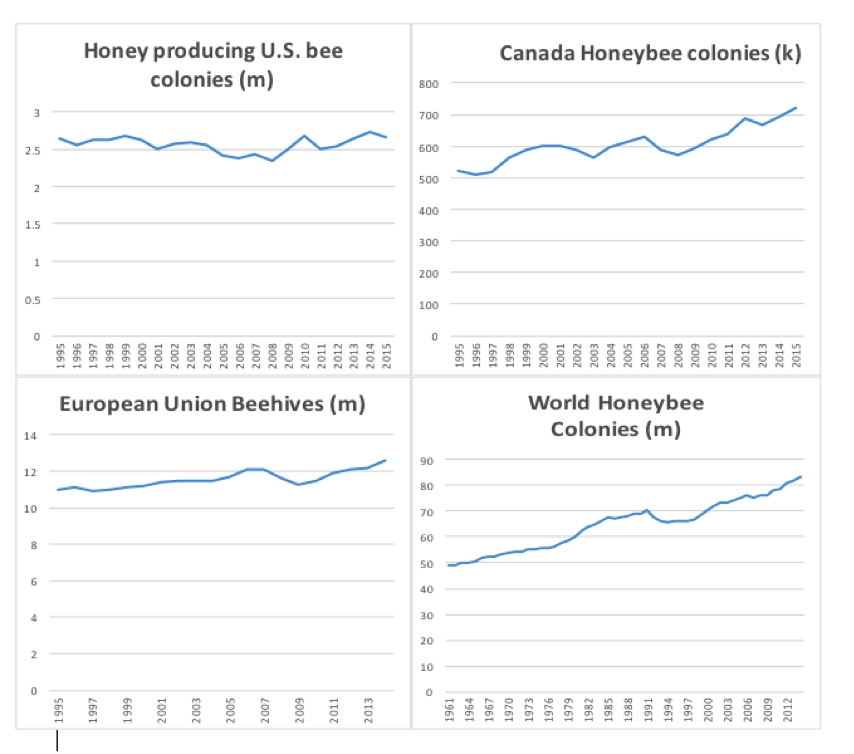
Taking the big picture view, North American, European and global bee hive numbers have risen steadily since the introduction of neonics, to record levels. Outside of a few states in the United States (most notably California) and sections of some countries in Europe, there is no crisis. And in places where neonic usage is highest—western Canada and Australia—bee health has never been better. Here are the number of bee colonies in key regions since the introduction of neonics in 1995:


What will The Times do?

When it comes to corralling support, activist environmentalists often focus on simple villains and frame issues in catastrophic terms. From Greenpeace’s campaign to force Shell to deep six the Brent Spar North Sea oil platform in the 1990s to the efforts by the Natural Resources Defense Council to replace harmless BPA in plastics with substitutes that are demonstrably harmful (BPS) to the ongoing but misplaced hysteria against DDT that the World Health Organization has said may have cost a billion lives, the ‘simple’ enemy-of-the-people target is sometimes benign, and its banning or removal often leads to far worse consequences.

The world’s top scientists cringe at the hyperbolic framing of environmental issues. When it comes to bees, National Medal of Science and Goldman Environmental Prize-winning bee expert Mae Berenbaum has called such scare claims unhelpful. “The rhetoric has gotten ridiculous. It is hyperbolic to talk about the apocalypse,” she said.

Faced with a slew of missteps in its coverage of the “beeapocalypse”, the Times might be well served to reflect on its neonics and bee crisis narrative. Next up for its editors: reporter Danny Hakim, who has faced sharp criticism from independent scientists for his reporting on the GMO debate, is taking on the bees and pesticides. The Times was unresponsive when scientists and science journalists challenged his prior reporting as biased (and in some cases factually inaccurate).

Is the Times willing to devote the time and resources to report on nuanced stories outside of its traditional fields of expertise? That would require a level of oversight at the vetting stage and after an article is written but before publication—which now appears to be lacking, at least on the issue of pollinators and pesticides.

Bees shouldn’t become the next ‘fake news’ victim.

Jon Entine, executive director of the independent foundation funded 501c3 Science Literacy Project (Genetic Literacy Project and Epigenetics Literacy Project), has been writing on biotechnology, chemicals, food and farming for more than 15 years, and recently hosted a Reddit Science discussion on bees and pesticides.

Wednesday, March 1, 2017

To help bees and farmers, EU should roll back ‘fear-based’ ban on neonicotinoid pesticides


[Editor’s note: The following is a letter by David Zaruk, Belgian-based environmental-health journalist specializing in science and public policy, to Vytenis Andriukaitis, EU commissioner in charge of Health and Food Safety.]

I understand that you belong to a Commission whose chief strategy seems to be expedience (the art of making issues go away). That is not leadership and in the case of the previous Commission’s 
decision to ban three essential and benign insecticides (known as neonicotinoids or neonics), this problem will not go away.

You have clear grounds to [retract the 2013 draft Bee Guidance Document] It was never approved by the European Council (for good reason); [the European Food Safety Authority] has learnt that their expert advisory working group had conflicts of interest which they had hidden from the authority; and the previous DG Sanco had several directors that had been found to be too close to anti-pesticide activist campaigners........To Read More.....