Search This Blog

De Omnibus Dubitandum - Lux Veritas

Showing posts with label Hank Campbell. Show all posts

Sunday, June 23, 2019

Science Saves an Old Chestnut

Genetic engineering rescues a tree from a threatening fungus.

By Hank Campbell 

A forest of chestnut trees ravaged by blight in Luray, Va. Photo: Library of Congress
 
A blight-tolerant American chestnut tree is the latest example of what the science community has begun to call a GRO—a genetically rescued organism. In the past century approximately four billion chestnut trees have been lost in the U.S. due to blight that spread when the Cryphonectria parasitica fungus arrived with chestnut trees imported from Asia. A once-dominant hardwood species is now rare.
Nature can be fickle, but using science to engineer solutions allows precise methods to combat natural pathogens. Some species are resistant to the fungus, and that’s why it makes sense to use transgenic tools to help the chestnut tree utilize beneficial genes from other plants—essentially vaccinating against the fungus.

It’s all part of a 28-year effort by the nonprofit American Chestnut Research and Restoration Project, led by the State University of New York’s College of Environmental Science and Forestry. Scientists use a gene from bread wheat that produces an enzyme called oxalate oxidase, which prevents the fungus from forming cankers on plant stems. The enzyme is found in all grain crops, plus bananas, strawberries and more..........To Read More.....

Saturday, January 26, 2019

A Flawed Science Journalism Article Provides Good Education On How We Can Do Better

By Hank Campbell | January 25th 2019 | Print | E-mail

Anti-science activists are having a field day on social media, happy that a poorly designed study can let them claim that human sperm is being damaged by modern pesticides, even though the study found nothing of the kind.

Nothing new there, it's how groups like US Right To Know and their parent, Organic Consumers Association, earn money from their clients. But the paper even made its way into a real article in a real paper in Australia, and since I was giving a private class for scientists who want to do outreach this week I used the article to show how journalists who don't understand science as well as scientists can be duped by an aggressive press release (from the University of Melbourne) and a corresponding author willing to sound truth-y, aided and abetted by a crash course at Google University. The journalist, Liam Mannix, is from Australia (Sydney Morning Herald) and I had never read his work before so it was easy to be more objective, even though it was on a topic that I have been writing on for years and so might be a psychological hot button. (1)

I did what I could to write my talk into an article, and I apologize in advance for my inability to be brief. Pictures tell a thousand words but in a class you use both and I did.........To Read More..

Monday, October 29, 2018

IARC Retraction Watch Begins: They Faked Images In Controversial Claims

By Hank Campbell — October 25, 2018 @ American Council on Science and Health

The International Agency for Research on Cancer (IARC) has a new leader, an Old Guard insider named Dr. Elisabete Weiderpass, who promised not to change the status quo, which means they remain stuck with an old problem; credibility.

While for its first 20 years they were a much-needed voice of reason that stood up to activists claiming that some new chemical of the month was a carcinogen because it could kill rats, for the last 10 IARC have been the source of ridicule among the science community. And that is because the environmentalists whose hype they once exposed played the long game and wormed their way inside.(1) Today, thanks to letting them hijack that science body, we are told to believe that a weedkiller can cause cancer and deli meat is as bad for you as plutonium or mustard gas. Such claims are literally baloney.

But media who love centralized authoritarian bodies and veils of anti-corporate credibility have gleefully reported each more cosmic claim from the French organization during that time. They have even touted media press releases distributed prior to actual reports as fact. Though IARC decisions do not consider risk (to determine a hazard they allow papers that show 5 orders of magnitude, so one dose of a compound is the same as 10,000 to them) the WHO group will mention risk dozens of times in media claims in their press releases.

There is just one problem they face: Every few years, a new crop of journalists enters the field, and not only might they not be in the bag for your brand of activism, they might be neutral and wonder why no one turns their gaze on the manipulations of supplement hucksters, alternative to medicine purveyors, and environmental lawyers. And some scientists who engage in public outreach are critical thinkers about studies everywhere, like molecular biologist Leonid Schneider and microbiologist Dr. Elisabeth Bik, who have called out groups who do this and also journal editors who enable them with a desire to publish provocative claims that will bring international media links.

A recent analysis of both journals and IARC involvement, titled WHO Cures Cancer In Photoshop, went into detail about the cultural flaws that allowed IARC to lose its way but more broadly about how easy it is to duplicate or reuse or slightly change graphics to look original in a science study. Some of the inferences I don't agree with - the involvement of a private sector scientist does not sway results by default, that is Cui bono? conspiracy signaling - but the overall examination is sound. (2)

Schneider is not alone in being concerned that IARC is trapped in the past using a methodology that is easily exploited by activists with nefarious agendas and patience, like Professor Martyn Smyth of Council for Education and Research on Toxics (CERT) (3) or Dr. Chris Portier of Environmental Defense Fund. They used 21st century strategy to infect a stodgy 20th century institution, which creates ad hoc working groups based on having friends inside, refuses to be transparent, and has no rules for the study of each compound. It has become just statisticians finding things to correlate to cancer. As Dr. Angela Logomasini of Competitive Enterprise Institute notes in the Washington Times, "The working groups are free to focus on myriad small-scale studies with implausible results. That can lead to cherry-picking that serves the biases of working group members."

It certainly has. Look at two California court cases, on coffee and on weedkiller, and the first thing you will find are two IARC participants mentioned above, Chris Portier and Martyn Smith, who have been paid by attorneys to help them sue companies.

Is there hope? There certainly is. The American Council on Science and Health Board of Scientific Advisors was part of a group of four people called on to testify before the U.S. House Science, Space, and Technology Committee about IARC and we recommended Congress use its financial leverage, and the credibility U.S. backing grants, to rein the rogue statistical body in.

The only opposition we faced on that panel was Natural Resources Defense Council's Dr. Jennifer Sass, who argued IARC's closed door mentality and lack of transparency about its working groups should remain untouched. That was the opposite of what she claimed in 2002 and when that was noted she could only reply, "2002 was a long time ago."

In many ways, this is true, and IARC should consider shucking off the parts of our past that no longer have validity in 2018.

NOTE:

(1) If your career goal is to get a fat paycheck as an expert witness or as a consultant at an environmental NGO, today there is a clear roadmap. First, write provocative epidemiology papers linking harmless things to health effects - it can be miracle vegetables creating eternal life or scary chemicals taking years away. Second, become a Washington insider and get a title, any title, from the National Institute of Environmental Health Sciences (NIEHS). If you are good with media and share the correct political proclivities, use that title to get quoted frequently in the New York Times. Soon enough, a litigation group like Earthjustice or Environmental Defense Fund or Center for Biological Diversity will start offering you money. And if you are really good at political maneuvering, you will get a slot on an IARC Working Group, where you can get the chemical you wanted banned all along subjected to a review. Once that is complete, you can claim to be a U.N. expert on the chemical you want banned while signaling to trial lawyers you are ready to "play ball", and then the expert witness checks will start coming in.
(2) "Apparently, by re-using certain western blot bands, a potential prevention therapy for cervical cancer can be established. Amazing research, done by WHO scientists at IARC, with public support."
He pulls no punches. You should read it.
Attention @PNASNews @jbiolchem @J_Immunol @ASMicrobiology @PLOSPathogens @JExpMed @ACasadevall1 Look what @IARCWHO published in your journals. https://t.co/PhM33CET8l
— Leonid Schneider (@schneiderleonid) October 11, 2018
(3) Despite its lofty name, CERT is not a council at all, there is no 300-person Board of Scientific Advisors like we have, it was instead created by Metzger Law group to have a non-profit to act as a front for lawsuits against companies - if it exists outside paper at all it now it seems to be "run" by a politically

Tuesday, October 23, 2018

PNAS And Microbiomes: Will They Publish A 'Study' About Bee Chakras Next?

By Hank Campbell — October 18, 2018@ American Council on Science and Health

Over the last 15 years, PNAS, the Proceedings of the National Academy of Sciences, has gone into serious decline. An organization once so prestigious Carl Sagan, the most prominent scientist in America, was unqualified to be admitted, is now scrambling to stay relevant. They recently announced they are going to cease print publication, but austerity is not their problem, embrace of junk science is.

There is no other way to categorize a recent paper suggesting the microbiome of bees may be at risk due to science.

Want to believe that hurricanes with female names are more dangerous because men are sexist? That was PNAS. Want to believe that black people look "blacker" during bad economic times? PNAS again. When Facebook manipulated user news feeds as a social experiment PNAS had no issue publishing the results. Had those claims been in obscure journals, none of them would have made their way into the New York Times, Washington Post, or other popular political newspapers that dabble in science.(1) Yet they did get in, and PNAS has remained relevant thanks to journalists who love to write about provocative claims they want to believe.(2)
And then there is the microbiome. Over the last century, there were 3 articles per year about our natural gut flora. Starting in 2011 we began to see three per day despite there being little more known about what good or bad might be for an average individual. Yet journalists love it, and supplement companies love it, and yogurt companies love it, and therefore some academics are going to write about it.

And if you really want to get media attention, use the pop science microbiome fad, throw in bees and chemicals, and then get it in PNAS.

PNAS, microbiome, bees, and glyphosate: The recipe for a mainstream media feast

Despite spending a fortune on ad campaigns and email blasts to journalists, activists have been unable to convince the public that bees are in decline when data show they are fine.(3) A recent PNAS paper avoids that pitfall by suggesting they are only not in decline yet. And if you believe any change must be a bad thing, then you are certain to believe glyphosate, a key ingredient in the weedkiller Roundup, could be the cause of change. The compound is in fashion for media again because a jury in California recently said that if a company can't prove that a chemical didn't cause a man's cancer, then they must pay trial lawyers $289 million.(4)

That's a perfect storm for PNAS so they recently published a paper noting glyphosate is changing the bee microbiome. You read that right, get those bees some probiotic yogurt.

Or not. First, the levels of glyphosate they used are not real world. Bees are not diving into vats of chemicals and swimming for 12 hours. And if they did do that, the response to higher doses of a chemical should be more change, yet in this paper low doses had more change. That is homeopathy, not science. Second, how do they know change is bad? Even the foremost expert in the bee microbiome is scientifically equivalent to being the tallest person in a room full of leprechauns. No one really knows anything yet.

In reality, it would be worrisome if a chemical did not change the microbiome of bees. Or yours. Or mine. I ate some delicious cinnamon bread from Trader Joe's while I wrote this. My microbiome changed, my hormones changed. Food and drink do that. But if I want to scare you, I could say Trader Joe's cinnamon bread contains an Endocrine Disrupting Chemical. Which is what anti-science conspiracy theorists like Pete Myers and a tiny cabal of political journalists (weirdly centered in the New York University Arthur L. Carter Journalism Institute run by someone who should know better, Perri Klass, M.D.) do.

As Dr. Josh Bloom noted, "Although the relative composition of the bee gut biome may have changed, none of the eight bacteria measured was eliminated. And there was no difference in the total number of bacteria in either the high-dose, low-dose, or placebo groups."
What is most telling to biologists; Roundup can only affect the shikimate pathway in plants. It can't do anything to you or me. Believing it does is like embracing chemtrails or that government is out to get your precious bodily fluids.

The next phase: Chemicals are changing human chakras (also available for bees and mice)

But I don't want activists to lose hope. Their efforts to claim insects birds bees wild bees bees are dying erratic changing is going to be aided as long as some academics want media attention. And activists can continue to move the goalposts to create media buzz some academics will want to capitalize on. If this latest stuff about a changing microbiome does not work, they can next contend GMOs neonics glyphosate are changing their chakras.

Or they can insert any popular chemical. I will make it easy for them with a simple chart showing which chakra will be changed by what common chemical. You are welcome, Greenpeace.


There is no question the woo contingent is where the money is at. A recent conference on "transcendental meditation" had Yogic Flying Instructors (though none have ever been filmed actually flying) but also Jerry Seinfeld, Hugh Jackman, and Katie Couric. The audience listened to militant anti-science cranks like John Fagan (5) spout nonsense such as "the rapid reversal of the U.S. food system from broad acceptance to widespread rejection of GMO foods correlates with a sharp increase in coherence in U.S. collective consciousness, when a large permanent group of TM practitioners was assembled in Iowa, USA.”(6)

That's right, he said they meditated in Iowa and more people nationwide bought organic food, $2 billion in activist groups promoting their corporate donors had nothing at all to do with it.
PNAS, you can do better.

NOTES:

(1) I have gone after them before. An article I wrote in the Wall Street Journal criticizing their policy that allowed Academy members to be pre-selected to do peer review for their friends and hand walk studies into publication forced them to change that policy. I first noticed it because of a 2002 paper by activist Tyrone Hayes, which claimed a weedkiller was essentially making male frogs more feminine. It got into the New York Times and thus got a special EPA panel called but the EPA wasn't able to use the study that got the panel called because the Berkeley professor refused to show his data. How did it get published if no peer review looked at data? The pre-selected reviewer was Hayes' friend and Academy member David Wake, whose wife chaired the department Hayes is in. No impartial reviewer ever saw it. And no one has been able to replicate the work of Hayes.
(2) Despite its decline, PNAS still has some cachet, the way Popular Science does even though they have become more of a lifestyle blog than a science magazine, Bonnier Corporation, the parent of Popular Science, Field & Stream, and numerous other publications, has to pay the bills but this is a bit much.

(3) Bees do have large periodic die-offs, those have been recorded for as long as records of bees have been kept (~1,000 years) and when one occurred in the 1990s, activists blamed sprayed pesticides. So science did something terrific; a seed treatment, when plants are most vulnerable to pests, based on a natural insecticide. Yet when another blip happened, activists blamed those. To no avail, bee numbers rebounded nicely. Then they claimed that wild bees were being harmed, which was at least clever, since there are ~25,000 species (we don't even know exactly how many) of bees and only 7 have hives so wild bees can't be counted, but even the staunchest supporters of environmental groups in the United States balked at that.
(4) The plaintiff will only get about $20 million of that $289 million, if it is not overturned. It's good to be a trial lawyer.
(5) Fagan created HRI Labs, which recently conducted a test that detected glyphosate in urine and then co-wrote a paper about it, with Paul Mills, who is a graduate of, you guessed it, the very same Maharishi University of Management in Iowa.
(6) Dear Mr. Seinfeld - you are a legendary comedian. Your job is to be skeptical and ridicule nonsense. Please tell me you were only there because the check cleared and you don't actually believe any of this nonsense.

Tuesday, August 14, 2018

The Grande Armee Of Big Organic May Be Marching Toward Its Waterloo

By Hank Campbell — August 10, 2018 @ American Council on Science and Health

If you were living in Austria, Russia, and Sweden in August of 1805, declaring war on France, led by the legendary tactician Napoleon Bonaparte, must have felt like a suicide mission. It basically was. He stomped through Europe and it was only seven years later, longer than all of World War II, when he finally made a mistake and tried to tough out a Moscow winter in the open.

Napoleon of 1805 is what fighting against the Grande Armee of Organic Food sometimes seems like. Nothing ever seems to go wrong for them. Numerous foodborne illness outbreaks are shrugged off - somehow people even continue to frequent Chipotle stores - and high prices are no deterrent. We've debunked their ridiculous claims about having no pesticides and being more nutritious and being able to feed the planet and being more ethical, but every time it seemed like they must collapse, they have turned certain defeat into Austerlitz. Except the Russians are on their side this time.

Yet Big Organic may be about to lose their Waterloo because, like Napoleon, they are wasting time at the agricultural equivalent of Chateau de Goumont (Hougomont) while the real enemy is about to come crashing down upon them.........To Read More.....

Wednesday, August 8, 2018

You'll Need To Re-Use That Cotton Shopping Bag 7,100 Times For It To Make Environmental Sense

By Hank Campbell — August 6, 2018 @ American Council on Science and Health

Companies left and right are banning plastic straws because ocean critters are important - with no evidence getting rid of plastic straws is really helping marine critters at all. While I shake my head at that, I am not surprised. The free market has spoken, companies respond to what consumers think they want. When activists and endocrine disruption magicians claimed BPA might be doing... something... the science community knew that if a chemical binds to estrogen 1/20,000th as well as actual estrogen, it is not doing anything, it is just a harmless trace chemical, but I was not surprised ConAgra took it out of their cans. The public were told they wanted that. The market responded and the cost was passed along to consumers.

I was also not surprised that environmentalists did not suddenly rush to buy Manwich without BPA lining in the cans, and the company laid off 1,500 people due to its higher costs and flat revenue.

Do you want a paper straw that won't work or a permanent one that will never be cleaned? The movement may be temporary. We may see a migration back to straws after the hype dies down, just like we saw a migration back to butter after food lawyers like Center for Science in the Public Interest could no longer hide that trans fats were not healthier because they came from plants. Even the U.S. Congress has undone flawed policies, like their boondoggle with corn-based utensils instead of plastic from 2007-2011. (1)

Before straws this year, there was a war on plastic bags, brought about by, you guessed it, environmental press releases and carefully staged photos of garbage. Now poor people have to pay for bags, a regressive tax, unless they can foot the upfront cost for buying bags. But how often do people really wash their bags? Ever? Well, rarely, a study found. Even the most casual cleaner knows you don't want meat drippings on your counter promoting illness the next time you make food, but most won't think about it in bags. And if you keep them in your trunk the bacteria could increase 10X.

But it's for Gaia.

Except it isn't. A recent study found that a cotton bag will need to be reused 7,100 times (2) for it to make sense from a Life Cycle Assessment environmental impact perspective. 7,100 times means that if you go grocery shopping once per week (and you shouldn't go more often because that's bad for the environment too) you will have to use that bag for 136 years.

As Dr. Trevor Thornton, Lecturer in the School of Life and Environmental Sciences at Deakin University phrased it, "Our assumptions about what is environmentally friendly don’t always stand up to scrutiny."

Which means we should scrutinize first, and waste money on alternatives later.
NOTES:

(1) In Science Left Behind (with Dr. Alex Berezow, before either of us were at the American Council on Science and Health) I wrote about the Congressional cafeteria replacing plastic utensils with compostable, corn-based environmentally terrific alternatives after Democrats gained control of the House in January, 2007. Environmentalists cheered. The Congressional buildings were miserable. The utensils broke and melted easily. Congressional accountants were baffled. The cost was incredibly high, and the utensils had to be shipped on giant, emissions-belching trucks to Virginia to be composted. When the House switched hands again in 2011, the outgoing head of the committee recommended to his replacement that they switch back and Rep. Lundgren of California did. Minority Leader Rep. Nancy Pelosi then claimed Republicans were giving people cancer with styrofoam and killing the environment with plastic.

(2) "Organic" cotton is even worse for the environment due to older production requirements in order to use the label.


Thursday, July 26, 2018

3 Reasons Aerial Pesticides Are Not Causing Autism

By Hank Campbell — May 2, 2016 @ American Council on Science and Health

Steven Hicks, M.D. PhD, pediatrician at Penn State Milton S. Hershey Medical Center in Hershey, Pennsylvania, looked at autism rates in a swampy region of New York and saw higher developmental delay and autism diagnoses in some areas and thinks he knows why; pyrethroid pesticides being sprayed by airplanes to kill mosquitoes.

Scientists, toxicologists, and public health officials certainly appreciate some attention being drawn to killing mosquitoes as the season — and Zika concern — approaches, but chemically it just can't be true, for three reasons:

1. Pyrethroids are less toxic than the popular home-use repellent DEET. DEET is even applied directly to the skin, where itis readily absorbed into the blood. It still isn't harmful, meaning pyrethroids are even safer.

2. There is no plausible biological mechanism for this correlation and none is proposed; it is simply two curves that happen to show an association, real or otherwise. It could just be a spurious correlation. For example, organic food sales have also increased with autism (1), which is obviously ridiculous. Furthermore, there are many reasons why people who live near swampland may seem to have more diagnosed developmental delays — a broadening of the definition of autism, and better reporting in areas that were not as well serviced before.

3. Pyrethroids have been used for 50 years, so they can't suddenly be causing autism. In the zip codes that were analyzed, 1 in 120 children was diagnosed with autism spectrum disorder or a developmental delay, while the same class of pesticides without aerial spraying was 1 in 172. Yet the prevalence nationwide for autism spectrum disorder is 1 in 68. From these data, it could be argued that pyrethroids lower the chances of autism, which is no more or less valid than these claims.

Hicks does not say he knows this correlation to be causative, he wants it "studied" more, but his supporting information is sketchy — he invokes a California paper regarding pregnant women and autism being linked to pesticides using proxies the same way, without noting that the paper was widely discredited because it did not measure any pesticides (2), it simply matched two curves as is being done with aerial spraying. The author also did not disclose two conflicts of interest— she is both an autism and an anti-pesticide activist.

Hicks' work has not been peer-reviewed yet (preliminary findings, presented at the Pediatric Academic Societies 2016 Meeting), so it is sadly both unfortunate and predictable that environmental groups are already exploiting developmentally disabled children and their parents by promoting this finding to raise money — and that publications like Newsweek are enabling them without any critical thinking.

NOTES:

(1) It's a serious issue, I don't want to be glib about it, but since every environmental group is glib about their curve matching when dialing for dollars:


2) Other flawed uses of proxies published as fact:

(1) Zebras evolved stripes due to flies
(2) Famous paintings are proof of climate change
(3) Bicep size correlates to political conservatism.
(4) A lack of vitamins is linked to more autism


Thursday, July 12, 2018

If Our Science Tribe Was a D&D Game

By Hank Campbell — June 28, 2018 @ American Council on Science and Health

Credit: Warrior and Mage by Liarath
I've never been much for the word "tribe." It sounds too insular in 2018, the kind of term (see also "zeitgeist", "heteronormative", and "schadenfreude") thrown around by barely literate postmodernists with their heads in the clouds believing what they tell each other as the real world passes by.
That's not to say it isn't an accurate description of science media.

We certainly have tribes: There are progressive ideologues in large media corporations denying reality as they frame science belief (and denial) through their politics; there are academics who believe the public simply have a deficit of information and showing them some Powerpoint
 
slides will fix it; we have zealots who believe every skeptical question must be met with fire and brimstone.

Heck, we have so many distinct tribes there will even be people who object that I wrote the word "we" - they will say science communication is their fiefdom, their domain, and anyone different from them is not really a science communicator.
Science media is fractured but other tribes, like environmental activists, have clearly been successful and have put aside their differences and flourished by working together. What separates them from us?

One big cultural difference is they don't let a few elites declare that success is a zero-sum game - if you win, they must lose. Starbucks made coffee an experience rather than a cheap drink with breakfast, but it did not put diners out of business. Starbucks instead caused all boats in that market to rise. Don't let anyone in science communication tell you that you can't be part of the tribe unless you are below them in the pecking order, or you must desire to work in corporate media. It's the kind of fake appeal-to-popularity narrative we oppose when activists do it to science. If you are new to science communication, we don't want to put you in your place, we want to publish you. Or you can write at Science 2.0 or ScienceBlogs or even start your own using Wordpress.

Science communication is like a game of D&D. Sometimes you find treasure, mostly you fight trolls.

If you don't know what Dungeons and Dragons is, I am not saying you won't be a successful science communicator, but you may lack some cultural instincts to do work that resonates with the public. No one cares about jargon, or drilling down into some arcane aspect of a field, except five of your friends. Metaphors enlighten, cultural references help. I used D&D because it has trolls, and so does the world of science. See how that works?

Anyway, if you don't know, D&D is a role-playing game invented in the 1970s - you pretend to be a character with other friends who are also characters in some mysterious or dangerous situation. Because it was based on long-standing fantasy archetypes, sword and sorcery like the worlds of R.E. Howard and Tolkein, the typical D&D group, the tribe, became a swordsman, a ranged weapon jack-of-all-trades, a magician scholar, and a clever thief or a mystic.(1) You can probably guess right away how those different types working together in science communication can be a great thing. If we can get people to do it.

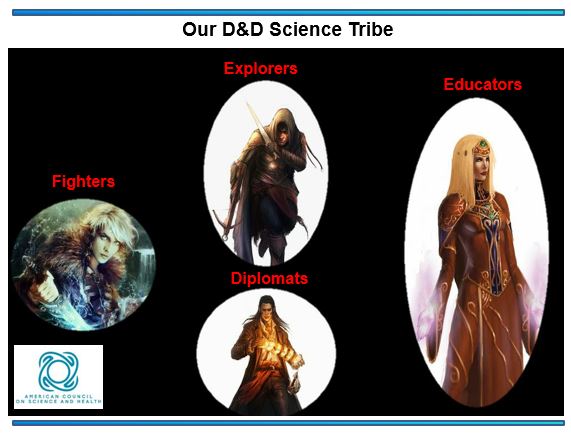
Science communication has similar archetypes: Fighters, Diplomats, Explorers, and Educators.
Credits Left to right: AniaMitura, Satibalzane, Liarath, Satibalzane
A Fighter is just what it sounds like. It would be great if we lived in a world where everyone was nice, no one lied, and we could all talk and then hug it out. But that's not reality. Some people have said the American Council on Science and Health (or me personally) would be more successful if we were just nicer. It's been tried for decades, by us and many others, and it failed. When has unilateral disarmament ever worked?

Anti-science activists have fighters and if we are all pacifists we'll quickly be overrun. Anyone who has had environmental groups terrorize their workplace or their home or been vilified in media because they stood up for science probably wishes they had someone to be the tip of the spear, or at least hold a shield, on their side. Someone like Dr. Alex Berezow or Dr. David Zaruk or David Gorski, MD, are a few examples of fighters in science communication. However, you've likely heard phrases such as 'if your only tool is a hammer, every problem is a nail' and that is why we can't have all fighters. If everyone is on the attack people will just be afraid.

An Explorer is like a missionary or a pioneer. They are going to leave our tribe and venture into uncharted wilderness. They do not attack the army of activism, they go around them and try to reach their supporters, who are likely well-meaning, genuine believers. If I see someone on the street canvassing for Greenpeace, I would never be hostile toward them even though I am a fighter. But if I see Ken Cook, who runs Environmental Working Group, or Andrew Kimbrell of Center for Food Safety, I am going after them, because I know they are frauds motivated solely by money.

An explorer won't bother with those guys at all, and will instead want to understand the motivations and values of their tribe members who distrust science. They have to have a lot of patience and a thick skin, because explorers are most likely to get arrows in the back. Examples of explorers are Prof. Kevin Folta, Vinay Prasad, M.D., and Dr. Jamie Wells. Since pioneers sometimes discover new lands or paths, they are needed, but they are not going to be equipped to fight off an army. They work best from a distance.

An Intellectual creates the informational tools that help fighters, explorers, and diplomats but they do not feel suited to those jobs. This will be most scientists, obviously, though will not be most science communicators. They are prized for being important sources of information, even if they don't relish the spotlight. Examples are Dr. Tommaso Dorigo, Jesse Ausubel, and Dr. Michael Dourson. Intellectuals need protection. Activists count on creating an "icy chill" effect on scholarly work by using Freedom of Information Act requests and emails to university administrators as weapons. If the public has already been reached by pioneers, or fighters can add protection, or diplomats can help with leaders, the work of intellectuals goes smoother.

A Diplomat looks for common ground. They want to build bridges between tribes. As such, they may want to cede points you don't like to concede and may want to fight just the really important battles, not every skirmish. One example: In the smoking cessation and harm reduction camps, for example, there are some who insist e-cigarettes (vaping et al.) are not tobacco products. We were diplomatic and testified at FDA that until there was an affordable optically pure nicotine that didn't come from a tobacco plant, it should be regulated as a tobacco product. FDA appreciated that, and were then more inclined to listen to us when we said the "grandfather" date for vaping devices under the "Deeming Regulations" should not be 2015, because it would create millions of casual criminals and help few people. They eventually changed the date for applications to 2022.  A diplomat will recognize that conflict is sometimes a necessary part of diplomacy but will want to try to talk things out first. Examples are Dr. Brandon McFadden, Dr. Steve Savage, or Dr. Tara Smith.

As you gathered, any of these alone is going to make for a terribly short engagement against a balanced army. Fighters are going to be contained by the popular opinion outrage crafted by diplomats and intellectuals on the other side, Explorers are going to be harmed in close combat, intellectuals won't leave the library if they are at risk, and other groups will never talk if they can just overrun diplomats. Our tribe needs to be like a D&D game if we want to beat back the hordes at the gate.

Which means just because someone has a different style than you, or different politics, or a different audience, doesn't make them wrong. If we can reach four readers with a diverse, balanced effort, two on each side, rather than two who already agree with us, let's get the four. And let's stop doing the job of activists for them by tearing each other down because we didn't like some retweet.

Which are you in our D&D science tribe?

There is really no right or wrong answer here, the only time there is a wrong one is if you are one thing and someone else declares you must be like them or you are not part of the tribe.
But if you are a science communicator, I am curious to see who you envision yourself as in a comment.

Note:

(1) In "Lord of the Rings", for example, you had a ranger, an archer, a magician, and a thief as the core characters. Arguably the strongest framework for what became D&D was Poul Anderson's "Three Hearts, Three Lions", where a soldier is transported to an alternate world and his allies are a swan maiden and a dwarf and they battle a dragon, a giant, a werewolf, and a troll.

Monday, April 16, 2018

Who Will Lead IARC? The Most Likely Choices, and My Prediction

By Hank Campbell — April 13, 2018 @ American Council on Science and Health

Christopher Wild, Ph.D., has been the director of the International Agency for Research on Cancer (IARC) since 2009 and during his tenure, the organization has been controversial. With recent rulings on bacon, coffee, and a mildly toxic pesticide, all of which have come down in defiance of every legitimate science body, there have been calls for Wild to resign or be fired from the once-respected body.

He has avoided being terminated but he leaves behind a group with a reputation far removed from the original IARC, whose first director, Dr. John Higginson, was so prestigious among the cancer community he was on the board of the American Council on Science and Health. Like the Council, the original IARC wanted to separate health threats from health scares. Under Wild, they use their press office to attack other agencies, to engage in activism, to brazenly claim they assess risk rather than determine a hazard for further study, and even to threaten pro-science groups who criticize them.

Wild will finally be gone, but undoing the damage he has done will take some time. As a result of his efforts, fellow activists have been placed inside and they have blocked out the world's top experts - from diesel to toxicology to pathology - because they will have consulted for industry. Meanwhile, they specifically exempted IARC insiders being paid by environmental groups from conflict of interest concerns. As you will see, one of the key people under consideration was not only being paid by an environmental group that raised millions campaigning against the herbicide IARC was evaluating, he signed a contract with a trial lawyer to be an expert witness against companies making the herbicide...before the IARC ruling was even released.

Next month, IARC is supposed to announce its new director, someone who will guide the organization for the next five years, and someone who will have to undo the damage Wild and his collaborators in the activist community have done to the reputation of scientific risk assessment.
Here is how I handicap the front-runners. Since this is a United Nations body (1), there is a lot more than science that goes into their decision, so I have tried to discuss those factors as well.
#1 - Dr. Joachim Schüz of Germany, received his Ph.D. in epidemiology from the University of Mainz.
  • Pros: He is an IARC insider. He is known to everyone in IARC as a reliable voice for the recent IARC approach to hazard assessment.
  • Cons: He is an IARC insider. They recognize they need to cast off the stigma of the Wild era and virtually his entire CV involves IARC. He is European. IARC has been at war with European scientists and agencies who have defied their recent claims. Except for the first director, IARC has always been led by a European and an organization in France always picking a European now looks too insular. 
#2 - Dr. Elisabete Weiderpass, now of Finland, received her PhD in epidemiology from Karolinska Institutet, and her M.D. in Brazil.
  • Pros: She has excellent credentials and IARC has never been led by a woman. You might think that shouldn't be an issue, but this is the U.N. They changed IPCC membership from being the world's most prominent climate voices to having geographical quotas so science is not always foremost. 
  • Cons: She is European, which hurts her almost as much as Schüz. She is married to Harri Vainio. While most of us believe that should never make a difference, we are in a world where the head of EPA can't even rent a bedroom in a property owned by the wife of an energy lobbyist without getting outrage from the New York Times. Vainio is very much part of the Old Guard at IARC, exactly the influence the agency wants to have less of starting in 2019, so this impacts her by association.
#3 - Dr. Chris Portier, now of Switzerland. Ph.D. in biostatistics from UNC Chapel Hill.
  • Pros: He is well-liked by the environmental community in the United States and Europe because of his advocacy work. He is American. Despite America being the world leaders in science, the dominant funder of IARC and the home of the U.N., Europeans have conscripted IARC as a French group and they want to be seen as more of an international body. He has extensive CDC and NIH experience.
  • Cons: Though Portier likely got the most nominations due to his outsized influence among the environmental community, he has a severe lack of credibility. He is the poster child for what has happened to the U.S. government's epidemiology work since Dr. Linda Birnbaum became the Director of the National Institute of Environmental Health Sciences. Like much of NIEHS now, he prefers statistical correlation over science. Ethical cloud. He lobbied IARC to declare any industry funding as reasons for exclusion from IARC voting while exempting his work for Environmental Defense Fund. He signed a contract with trial lawyers seeking to sue Monsanto over the herbicide glyphosate before the IARC finding was even released. Age. At 62, he is already at the age where the WHO expects mandatory retirement so he would need a waiver.
#4 - Dr. Shuji Ogino, now of the United States. M.D. from the University of Tokyo School of Medicine and Ph.D. in Pathology from the University of Tokyo Graduate School of Medicine.
  • Pros: He has excellent credentials and is Asian. The only place with fewer IARC directors than the United States is the entire eastern half of the world. He is a Professor in the Department of Epidemiology at Harvard T.H. Chan School of Public Health, arguably the most important epidemiology group on Earth, which would show the U.S. Congress, which has IARC in their crosshairs to eliminate and replace with something more modern, that they are serious about scientific reform. He is a pathologist, which steers the organization away from simply using statistical correlation to claim things cause cancer, even if the dose difference is five orders of magnitude, in defiance of common sense.
  • Cons: He is Asian and Europeans may want to diversify but not that much. They may prefer a European woman over an Asian man.
#5 - Dr. Sten Dillner of Sweden. M.D. and Ph.D. from Karolinska Institutet.
  • Pros: He has excellent credentials. He is a virologist, which steers the organization away from epidemiology and simply using statistical correlation to suggest causation, which has plagued them in the recent past.
  • Cons:  He is European. This may be the year that IARC uses the controversy created by Wild to opt for more diversity, and Europeans will have a harder time locking it up for their own once again.
#6 - Outside shots. In my discussions, Schuz and Portier are very unlikely because of their link to the IARC scandals but anything can happen. There are other "dark horse" candidates who are also well regarded epidemiologists and could get the nod: Dr. Anna Giuliano, Founding Director of the Center for Infection Research in Cancer at Moffitt Cancer Center & Research Institute in Tampa; Dr. David Richardson, Director, Program in Occupational Epidemiology at UNC Chapel Hill; Dr. David Whiteman, Deputy Director at QIMR Berghofer Medical Research Institute in Brisbane.

My prediction: Shuju Ogino. No one will go on the record, of course, but privately representatives from Netherlands, Belgium, and Spain recognize they need more diverse leadership than they can get out of Europe's current candidates, even though two of the Europeans are well-qualified. The wild card is the United States. India, Qater, Morocco and Brazil will likely follow the U.S. lead but while the U.S. State Department casts the vote, the recommendation will come from the National Cancer Institute. Chris Portier is radioactive in American government circles now but his old boss Linda Birnbaum is not, and she may be pressing for IARC to keep the status quo, which would mean she wants Elisabete Weiderpass. I am told Australia will vote for Ogino even though an Australian is on the list, because they won't want to lodge a protest vote.

Either the first vote will come down along predictable lines but then they will want to reach a consensus and Ogino will get the nod. Or the Old Guard will win and their safe choice,Weiderpass, will sail through without any resistance at all. It's IARC, which means it is more politics than science.

NOTE:

(1) The 25 voting countries are the founding members - Germany, France, Italy, the United Kingdom and the United States of America - plus Australia, Austria, Belgium, Brazil, Canada, Denmark, Finland, India, Ireland, Japan, Morocco, Norway, the Netherlands, Qatar, Republic of Korea, Russian Federation, Spain, Sweden, Switzerland and Turkey.