Brian Joondeph June 18, 2019
Every week there is another health pronouncement saying what is now good for you and what is going to kill you. Unfortunately, the “what” is often interchangeable -- what was supposed to kill you last week is now suddenly good for you or vice versa.
Foods, supplements, and activities, all studied extensively and determined to be either good or bad, then subject to a new study, with the opposite conclusion. How can this be? Is the science that fickle? Or is this lousy research?
Some studies note an association which they spin as causation, like determining that older ladies who play bingo often have blue hair, an association that has nothing to do with cause and effect. Other studies are based on computer models which like most climate models, fail miserably at predicting future events.
Let’s take a look at some of the settled medical science that quickly became fake news............
To Read More
Showing posts with label Studies. Show all posts
Showing posts with label Studies. Show all posts
Tuesday, June 18, 2019

Tuesday, June 4, 2019
Chemistry Papers Are Retracted Mostly Due to Plagiarism, Data Manipulation
By Alex Berezow — May 28, 2019 @ American Council on Science and Health
Retractions in science are a fact of life. Sometimes, the published literature is wrong, and when it is discovered, the paper is often stricken from the scientific record.
We would like to believe that most retractions are due to honest errors, for example, accidentally mixing up control and experimental groups. We don't want to believe that most retractions are for nefarious reasons, like fraud.
Unfortunately, new research by François-Xavier Coudert published in the journal Chemistry of Materials does not reveal happy data. Dr. Coudert found 331 papers in the fields of chemistry, materials science, and chemical engineering that were retracted in 2017 and 2018. The overall retraction rate (about 3 per 10,000) is low, which is good news, but the reasons for the retractions were disheartening.
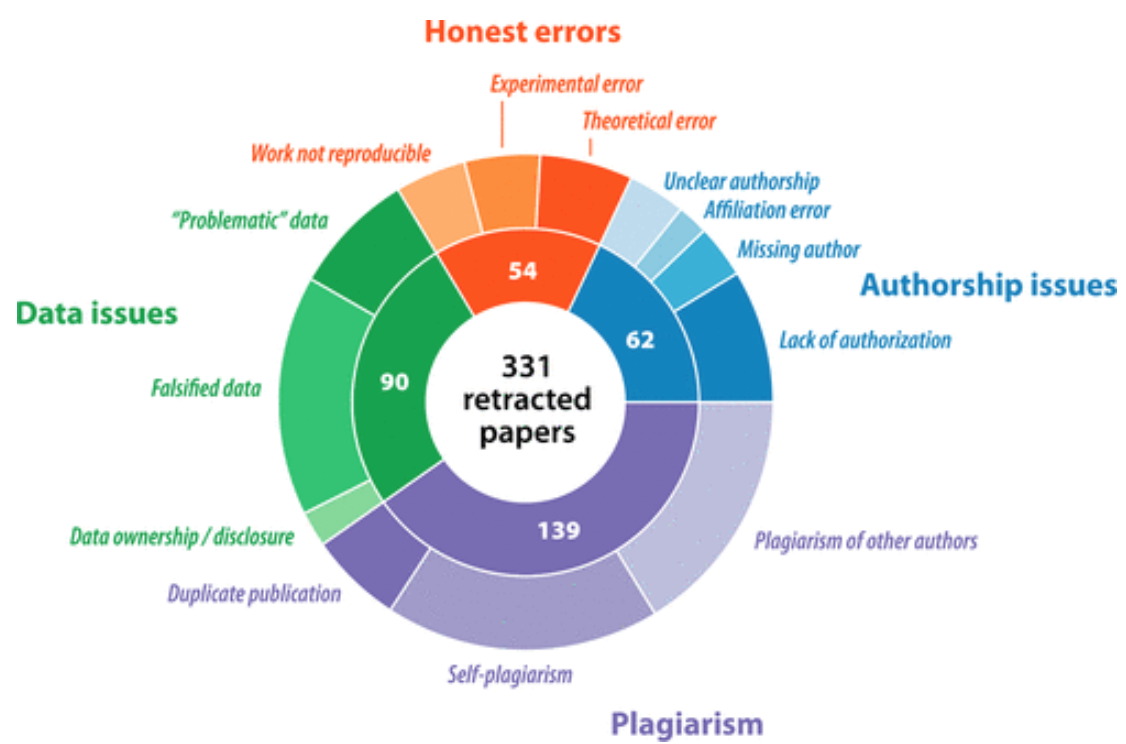 Dr. Coudert learned that 229 of the 331 papers (69%) were retracted for plagiarism and "data manipulation," which, more often than not, is a nice way of saying "fraud." (See chart.) Only 54 of the papers (16%) were retracted due to "honest errors."
Cheater, Cheater, Pumpkin Eater
Obviously, this is not good news, but there could be another explanation for the data: Systematic bias in which papers are retracted.
Plagiarism is relatively easy to catch. If somebody copies and pastes entire tracts of text, often somebody will notice. (Besides, we now have software that screens for plagiarism.) Fabricated data is much harder to catch, but an eagle-eyed scientist might notice irregularities with digital images that may indicate manipulation or data that looks "too good to be true." If detected, plagiarism and data manipulation are slam-dunk reasons to retract a paper.
That isn't necessarily the case for "honest errors" for two reasons. First, honest errors are exceedingly difficult to catch. Second, if scientists believe that the authors of another paper committed an error, they often address it by performing a better experiment and/or publishing a response. In this way, the scientific record is self-correcting, and there isn't as compelling a reason to retract a paper just because something in it is wrong. In this way, a systematic bias in retractions may be responsible for Dr. Coudert's findings.
If this analysis is correct, the good news is that fraud is still likely a minor problem. The bad news, however, is that there are a lot of honest errors out there in the published record which have yet to be detected.
Source: François-Xavier Coudert. "Correcting the Scientific Record: Retraction Practices in Chemistry and Materials." Chem. Mater. 31(10): 3593-3598. Publication Date: May 28, 2019 DOI: 10.1021/acs.chemmater.9b00897
We would like to believe that most retractions are due to honest errors, for example, accidentally mixing up control and experimental groups. We don't want to believe that most retractions are for nefarious reasons, like fraud.
Unfortunately, new research by François-Xavier Coudert published in the journal Chemistry of Materials does not reveal happy data. Dr. Coudert found 331 papers in the fields of chemistry, materials science, and chemical engineering that were retracted in 2017 and 2018. The overall retraction rate (about 3 per 10,000) is low, which is good news, but the reasons for the retractions were disheartening.
Dr. Coudert learned that 229 of the 331 papers (69%) were retracted for plagiarism and "data manipulation," which, more often than not, is a nice way of saying "fraud." (See chart.) Only 54 of the papers (16%) were retracted due to "honest errors."Cheater, Cheater, Pumpkin Eater
Obviously, this is not good news, but there could be another explanation for the data: Systematic bias in which papers are retracted.
Plagiarism is relatively easy to catch. If somebody copies and pastes entire tracts of text, often somebody will notice. (Besides, we now have software that screens for plagiarism.) Fabricated data is much harder to catch, but an eagle-eyed scientist might notice irregularities with digital images that may indicate manipulation or data that looks "too good to be true." If detected, plagiarism and data manipulation are slam-dunk reasons to retract a paper.
That isn't necessarily the case for "honest errors" for two reasons. First, honest errors are exceedingly difficult to catch. Second, if scientists believe that the authors of another paper committed an error, they often address it by performing a better experiment and/or publishing a response. In this way, the scientific record is self-correcting, and there isn't as compelling a reason to retract a paper just because something in it is wrong. In this way, a systematic bias in retractions may be responsible for Dr. Coudert's findings.
If this analysis is correct, the good news is that fraud is still likely a minor problem. The bad news, however, is that there are a lot of honest errors out there in the published record which have yet to be detected.
Source: François-Xavier Coudert. "Correcting the Scientific Record: Retraction Practices in Chemistry and Materials." Chem. Mater. 31(10): 3593-3598. Publication Date: May 28, 2019 DOI: 10.1021/acs.chemmater.9b00897
Saturday, February 23, 2019
Eisenhower's Less Famous Warning: Government-Controlled Science
By Hank Campbell — December 26, 2017 @ American Council on Science and Health
A few times per year we have a meeting of the Trustees of the American Council on Science and Health, to discuss issues like finances (1), to discuss nominees for our Board of Scientific Advisors, and our general direction.
 |
| From Dr. Strangelove. Credit: Columbia Pictures |
Among our Trustees is Fred Smith, the founder of Competitive Enterprise Institute (CEI), which promotes the benefits of free markets. I certainly agree with them on that (2). At our November meeting Fred asked for a spot on the agenda to talk about how we can better talk about science policy without getting into politics.
That is obviously tricky. Science is both corporate and political, when it comes to basic research the private sector and government fund about half each, so if you defend science you are implicitly defending corporations and engaging in politics.
It wasn't always that way. Ernest Lawrence, whose name is now on both Lawrence Berkeley National Lab and Lawrence Livermore National Lab, ushered in the era of academic Big Science. He found that if you did what government wanted, they would throw money at you. And then you could use some of that money to do what you wanted. It really caught on after the Manhattan Project, which was the ultimate use of government guiding academic research to create applied science. People whose entire labs were funded with less than $20,000 per year saw Lawrence getting hundreds of thousands, and then millions, from Uncle Sam and the race was on: Government was firmly in the science business and academics wanted to be in business with politicians. (3)
Not everyone was pleased by that. Most famous of the concerned about this new control of basic research by the government was President Dwight David Eisenhower - "Ike." Ike was someone so concerned about keeping politics out of strategic resources he refused to vote while he was a military officer. To him, it was a conflict of interest because he was paid by the government. His concern only grew while he was president during the bulk of the 1950s and government took more and more control of science funding. As politicians funded more of it, he believed, academia was going to self-select for those who also believed in big government and it would no longer be non-partisan. And corporations were going to control academic science by controlling politicians. Academics who "play the game" were going to get more funding and head up grant committees and panels. (4)
The concern about the growing "military-industrial complex" from Ike's 1961 farewell address - most alarming because he was a career military man who won War World II in Europe before he became President partly thanks to the military-industrial complex - became part of the cultural lexicon. But less well known is his second warning, about manipulation of academia by political interests, which Fred discussed in 2011 and passed around at our meeting.
President Eisenhower surrounded himself with brilliant academics, he knew that science ended World War II without costing another million American lives, but by 1961 he also knew "we must also be alert to the equal and opposite danger that public policy could itself become the captive of a scientific-technological elite.”
He worried about that government control over funding would change the nature of the “free university, historically the fountainhead of free ideas and scientific discovery.” And it has. If you want to find happiness in academia, find a humanities professor at a small college. If you want to find pressure, go to a biology lab at Johns Hopkins, which needs $300 million a year from the NIH if it's going to put up new buildings and recruit key names who can then raise more money from NIH.
Ike was right about culture as well.
A decade after his speech, academia was still politically balanced and conservatives had the most trust in academic science, but by the 1980s they had begun to self-select for people who liked government funding. They even began to suggest that corporate science - the companies who put men on the moon and develop the vaccines and antibiotics and the GMO insulin that have saved hundreds of millions of lives - meant less independence. Academia meant freedom. You're a liberal because you're just smarter. (5) It's reality that when people know you are partisan, they trust your objectivity less even if you are on their side. Today, only liberals retain historical high levels of trust in the impartial nature of academic science. Conservatives, libertarians, and progressives do not.
But now that tide is turning again. A new generation of science academics are starting on their third post-doc position and questioning the Old Guard's claims that corporate funding is wrong and only government is right and you can't be a scientist unless you are a liberal.
They realize that taxes are finite and that billions of dollars in federal government marketing about STEM careers in academia have led to a glut in Ph.D. supply, and there are academic jobs for just 16 percent of graduating scientists. They have become pawns for scientific-technological elites with little chance of getting a seat at the table, just as President Eisenhower warned.
Given that milieu, how can we discuss policy without getting into partisan politics? It isn't easy.
Virtually 100 percent of health and two-thirds of science policy are dictated by politicians. And it shows. For example, Syngenta makes an herbicide known as atrazine and when the Obama administration came into office, they convened two separate assessments on it to see if it was an endocrine disruptor in frogs.
That was not science, the EPA during the Bush administration had already checked that claim when it got publicity in the New York Times in 2002. That EPA was again forced to revisit the same product twice in just President Obama's first time certainly smacked of politicization of science.
In early 2016, our CDC began promoting a condition termed "prediabetes", which other countries claim is ridiculous, especially at the arbitrary blood sugar level our government chose. The CDC also declared that nicotine won't stop smoking - unless it's in a patch sold by pharmaceutical giants - and that the opioid epidemic was caused by the medical community and pain patients rather than recreational users.
EPA declared that small micron particulate matter was causing acute deaths even though there were none, not even during the entire history of EPA. US Fish and Wildlife Service told a landowner in Louisiana to tear down their forest and build a new one for a frog they declared endangered - in Mississippi. We have to talk about those bad policy decisions if we are going to honor our mandate to be trusted guides for the American public on complex issues.
Government-controlled science may be here to stay but that doesn't mean we have to accept rule by a scientific-technological elite that likes thrives on social authoritarianism. There are 300 members of the American Council on Science and Health Board of Scientific Advisors, and if a scientist or doctor wants to put politics first, they are not participating in our work exposing merchants of doubt who manufacture fears about trace chemicals, food, energy, and medicine.
So you can trust them, and going into our 40th year of separating health scares from health threats, you can be certain we'll continue to earn your trust as well.
NOTES:
(1) Never good - environmentalism is 1000X more lucrative because people send money when they are petrified, but 'your food is safe' is a terrible call to action.
(2) I was in the nascent physics software business when Japan was heavily subsidizing the semiconductor industry. Academics insisted our government needed to also subsidize it or we would "lose leadership" to Japan. I argued that the moment government got involved, RAM was going to cost $1 a MB because historically that was true.
In that same vein, delivering a brutal hit against the government mentality at the National Institutes of Health, Samuel Broder, former Director of the National Cancer Institute, once said, "If it was up to the NIH to cure polio through a centrally directed program instead of independent investigator driven discovery, you'd have the best iron lung in the world, but not a polio vaccine."
It has gotten no better today. We are funding a ridiculous "cancer moonshot" without using what made the Apollo program successful - corporations who competed to create the lowest price. The federal government had little to do with it. If you look at the spec for the original Mercury program from the government, it was laughable. Companies made it happen.
(3) And the private sector happily gave way where they could. Why fund expensive basic research, where only 1 in 1,000 things may work out, and put your shareholders at risk when you can get hundreds of millions of taxpayers to do it? Bonus: academics will believe they are more independent if we get government to approve the grant lobbyists said should be the direction of science funding.
(4) He seems to have been right. Look at the outrage when EPA declared that EPA-funded scholars could not be on panels determining EPA policy. Outraged academics did not see it as mitigating an obvious conflict of interest, they ridiculed that EPA did not even want research it funded. Do these same academics also insist corporate scientists be on government committees approving their drugs and chemicals?
(5) At SUNY-Albany Ron McClamrock summed up the common belief, which reached its apex in the mid-2000s. "We outnumber them because academic institutions select for smart people who think their views through; and if you're smart, open-minded, and look into it carefully, you're just more likely to end up with views in the left half of contemporary America. Which is just to say: Lefties are overrepresented in academia because on average, we're just f-ing smarter."
That sentiment is now considered laughable because "lefties" deny the science behind medicine, food, energy and chemicals so reliably you can predict someone's voting habits based on if they buy organic food, supplements, think fracking will cause the earth to deflate, and that BPA is an endocrine disruptor.
Saturday, January 26, 2019
A Flawed Science Journalism Article Provides Good Education On How We Can Do Better
By Hank Campbell | January 25th 2019 | Print | E-mail
Anti-science activists are having a field day on social media, happy that a poorly designed study can let them claim that human sperm is being damaged by modern pesticides, even though the study found nothing of the kind.
Nothing new there, it's how groups like US Right To Know and their parent, Organic Consumers Association, earn money from their clients. But the paper even made its way into a real article in a real paper in Australia, and since I was giving a private class for scientists who want to do outreach this week I used the article to show how journalists who don't understand science as well as scientists can be duped by an aggressive press release (from the University of Melbourne) and a corresponding author willing to sound truth-y, aided and abetted by a crash course at Google University. The journalist, Liam Mannix, is from Australia (Sydney Morning Herald) and I had never read his work before so it was easy to be more objective, even though it was on a topic that I have been writing on for years and so might be a psychological hot button. (1)
I did what I could to write my talk into an article, and I apologize in advance for my inability to be brief. Pictures tell a thousand words but in a class you use both and I did.........To Read More..
Sunday, July 8, 2018
Beware those scientific studies -- most are wrong, researcher warns
Ivan Couronne AFP July 05, 2018
Their investigation touched on a known but persistent problem in the research world: too few studies have large enough samples to support generalized conclusions.
But pressure on researchers, competition between journals and the media's insatiable appetite for new studies announcing revolutionary breakthroughs has meant such articles continue to be published.
"The majority of papers that get published, even in serious journals, are pretty sloppy," said John Ioannidis, professor of medicine at Stanford University, who specializes in the study of scientific studies.
This sworn enemy of bad research published a widely cited article in 2005 entitled: "Why Most Published Research Findings Are False."
Since then, he says, only limited progress has been made...........To Read More.....
Washington (AFP) - A few
years ago, two researchers took the 50 most-used ingredients in a cook book and
studied how many had been linked with a cancer risk or benefit, based on a
variety of studies published in scientific journals.
The result? Forty out of
50, including salt, flour, parsley and sugar. "Is everything we eat
associated with cancer?" the researchers wondered in a 2013 article based
on their findings.Their investigation touched on a known but persistent problem in the research world: too few studies have large enough samples to support generalized conclusions.
But pressure on researchers, competition between journals and the media's insatiable appetite for new studies announcing revolutionary breakthroughs has meant such articles continue to be published.
"The majority of papers that get published, even in serious journals, are pretty sloppy," said John Ioannidis, professor of medicine at Stanford University, who specializes in the study of scientific studies.
This sworn enemy of bad research published a widely cited article in 2005 entitled: "Why Most Published Research Findings Are False."
Since then, he says, only limited progress has been made...........To Read More.....
Subscribe to:
Posts (Atom)