Search This Blog

De Omnibus Dubitandum - Lux Veritas

Showing posts with label Population Control. Show all posts

Thursday, August 16, 2018

Maybe the Collectivists Will (Un)Breed Themselves Out of Existence

September 10, 2009 by Dan Mitchell @ International Liberty

(Editor's Note:  Although this is a "Blast From the Past", nothing has changed.  The thoughts and concepts are still the same nine years later.  If I'm still alive in nine years and republish this article all the thoughts and concepts would still be applicable.  RK)

The UK-based Telegraph reports that some outfit called the Optimal Population Trust is suggesting that people should have fewer babies to fight supposed global warming (or climate change, or whatever they’re calling it now). This is a reflection of the people-are-bad mentality that seems disturbingly common among enviro-statists:

The report, Fewer Emitter, Lower Emissions, Less Cost, concludes that family planning should be seen as one of the primary methods of emissions reduction. The UN estimates that 40 per cent of all pregnancies worldwide are unintended. …Roger Martin, chairman of the Optimum Population Trust at the LSE, said: “It’s always been obviously that total emissions depend on the number of emitters as well as their individual emissions.
 
Reading this article, though, reminded me of another article from a British paper. As this story from the Daily Mail explains, some radical environmentalists are deliberately choosing to sterlilize themselves to avoid having kids:

Had Toni Vernelli gone ahead with her pregnancy ten years ago, she would know at first hand what it is like to cradle her own baby, to have a pair of innocent eyes gazing up at her with unconditional love, to feel a little hand slipping into hers – and a voice calling her Mummy. But the very thought makes her shudder with horror. Because when Toni terminated her pregnancy, she did so in the firm belief she was helping to save the planet. …Incredibly, so determined was she that the terrible “mistake” of pregnancy should never happen again, that she begged the doctor who performed the abortion to sterilise her at the same time. He refused, but Toni – who works for an environmental charity – “relentlessly hunted down a doctor who would perform the irreversible surgery. …”Having children is selfish. It’s all about maintaining your genetic line at the expense of the planet,” says Toni, 35. “Every person who is born uses more food, more water, more land, more fossil fuels, more trees and produces more rubbish, more pollution, more greenhouse gases, and adds to the problem of over-population.” …Toni is far from alone. When Sarah Irving, 31, was a teenager she sat down and wrote a wish-list for the future. …Most young girls dream of marriage and babies. But Sarah dreamed of helping the environment – and as she agonised over the perils of climate change, the loss of animal species and destruction of wilderness, she came to the extraordinary decision never to have a child. “I realised then that a baby would pollute the planet – and that never having a child was the most environmentally friendly thing I could do.” …Mark adds: “Sarah and I live as green a life a possible. We don’t have a car, cycle everywhere instead, and we never fly. “We recycle, use low-energy light bulbs and eat only organic, locally produced food. “In short, we do everything we can to reduce our carbon footprint. But all this would be undone if we had a child.”
 
Think about what this means. If the nut-job environmentalists persist in not having kids, that almost surely means the world’s population will gradually become more sensible about these issue since mommy and daddy enviro-statist won’t be raising little interventionists to plague future generations.

Sounds like a win-win situation for everyone.
 

Sunday, February 4, 2018

The Policy Solution to the World’s Demographic Problem

December 8, 2017 by Dan Mitchell @ International Liberty

I wrote yesterday about “the world’s demographic problem,” citing a new study about the fiscal implications of aging populations. The report was produced by the Organization for Economic Cooperation and Development, which is not my favorite international bureaucracy when they make policy recommendations, but I’ll be the first to admit that the bureaucrats produce some useful statistics and interesting reports.

To be succinct, the basic message of the study is that developed nations (the U.S., Europe, Asia, etc) face a demographic nightmare of increased longevity and falling birthrates.

It’s good that people are living longer, of course, and there’s nothing wrong with people choosing to have fewer kids. But since most governments maintain tax-and-transfer entitlement programs, the OECD report basically warns that those demographic changes have some very grim fiscal implications. In other words, the world’s demographic shift is actually a policy problem.
That’s the bad news.

The good news is that there’s a policy solution.

The aforementioned OECD study (which can be accessed here) is a survey of how retirement income is provided in key nations. So in addition to grim information about fiscally unstable government-run retirement systems we looked at yesterday, the report also has data about the nations that rely – at least to some degree – on private savings.

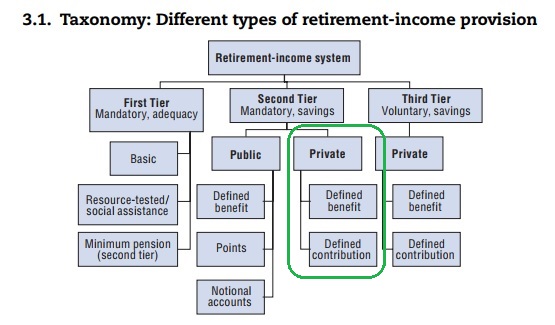
Let’s start with this helpful flowchart in the report. It illustrates that there are three approaches for the provision of retirement income. The first tier is government-run programs such as the U.S. Social Security system and the third tier is voluntary savings such as IRAs and 401(k)s in America.

For today’s discussion, let’s focus on the second tier. These are the systems that are “funded” with mandatory savings.

 
And I highlighted (in green) the two private options. In a “defined contribution” system, retirement income is determined by how much is saved and how well it is invested. Workers accumulate a big nest egg and then choose how to spend the money when retired. In a “defined benefit” system, workers are promised a pre-determined level of retirement income and the managers of their pension funds are expected to ensure that enough money will be available.

Yes, public options based on real savings do exist. And they presumably are better than the pay-as-you-go, tax-and-transfer schemes found in the first tier. But it’s also the case that these systems (such as pension funds for state and local bureaucrats) generally don’t work very well.

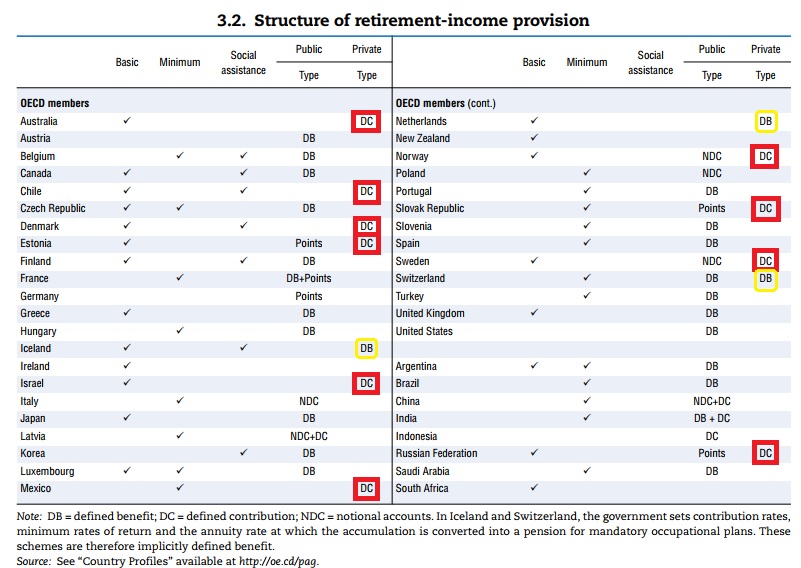
So now let’s look at another table from the OECD report. It shows nations that have some degree of mandatory private retirement savings, either defined contribution (highlighted in red) or defined benefit (highlighted in yellow). As you can see, there actually are a lot of “privatized” systems.


I’ve actually written about many of these systems, especially the ones in Australia and Chile.
And I have very recent columns on the Dutch and Swiss systems.

A common theme in these columns is that government-run systems are very risky because workers are at the mercy of politicians, who are great at making extravagant promises. But huge unfunded liabilities show that they’re not very good at delivering on those promises.

Nations with funded systems, by contrast, accumulate private savings. That’s not only good for workers, but it’s very beneficial for national economies.

This table from the OECD report shows that Americans and Canadians have managed to save a lot of money, but all of the other nations with pension assets of more than 100 percent of GDP have mandatory funded systems.


When I talk about how the United States would benefit by moving to a private retirement system, people sometimes say it sounds too good to be true.

That’s obviously not the case since other nations have very successful private systems. But there is a catch, as I acknowledged in 2015.
…a big challenge for real Social Security reform is the “transition cost” of financing promised benefits to current retirees and older workers when younger workers are allowed to shift their payroll taxes to personal accounts. Dealing with this challenge presumably means more borrowing over the next few decades.
The appropriate analogy is that shifting to private retirement accounts for younger workers (while protecting current retirees and older workers) would be like refinancing a mortgage. The short-run costs might be higher, but that temporary burden is overwhelmed by the long-run savings. That’s a good deal, at least if the goal is fiscal stability and secure retirement.

Or we can stay with the current approach and become another Greece.

P.S. Social Security reform is especially beneficial for blacks and other minorities.

P.P.S. There is some risk with personal retirement accounts. But I’m not talking about the implications of a falling stock market crash (even a horrible crash would be offset by decades of compounding earnings). Instead, I’m referring to the possibility that future politicians might simply confiscate the money.