Search This Blog

De Omnibus Dubitandum - Lux Veritas

Showing posts with label Green Scare Mongering. Show all posts

Saturday, August 22, 2020

Viewpoint: ‘Health impact of chemicals doubled in last 5 years’? Gullible media misreporting flawed studies mislead the public

| August 19, 2020

This article or excerpt is included in the GLP’s daily curated selection of ideologically diverse news, opinion and analysis of biotechnology innovation.  Plastics and pesticides: Health impacts of synthetic chemicals in US products doubled in last 5 years, study finds,” a July 22 CNN headline announced to the world. Referring to a paper recently published in the journal Lancet Diabetes and Endocrinology, the media outlet told its readers in no uncertain terms what’s at stake:
The proof is piling up: Many synthetic chemicals can harm your health and that of your children. Evidence has doubled in the last five years about the negative impact on our health of endocrine-disrupting chemicals in plastics, pesticides, flame retardants and other merchandise….
“It’s a global problem,” the paper’s senior author told CNN. “These are chemicals used in consumer products all across the world.”...............

In fact, the astounding claim that the “health impact of synthetic chemicals in US products” has doubled in the space of five years is in no way supported by the Lancet analysis. The media coverage of the paper, and indeed the paper itself, are part of a decades-long trend among some scientists and activists to amplify the risk of exposure to chemicals in consumer products far beyond what can be justified by the evidence..............

A key fact that the review authors failed to acknowledge anywhere in their paper is that most of the exposures reported in the studies they examined add up to trace amounts of the various compounds. That is, they can be detected with sophisticated analytical techniques but are below the level where they are likely to cause any harm.  This poses a problem for epidemiologic studies..........While focusing on trace chemical residues, studies investigating EDCs often fail to account for the many lifestyle factors that have documented health effects and are likely to dwarf the possible impacts of EDCs................

This conclusion deserves careful scrutiny for many reasons, the most important being that the Lancet review and the new JAMA Network Open study failed to acknowledge that BPA has been the subject of extensive, high-caliber research over the past two decades. This research has demonstrated that human exposure to BPA is extremely low and that the compound is efficiently metabolized and excreted in urine, even in infants. Furthermore, BPA’s estrogenic potency is orders of magnitude lower than that of the natural hormone estradiol.
In their introduction, the authors of the Lancet paper referred to DDT, an insecticide whose indiscriminate use following World War II gave rise to the environmental movement in the 1960s. But the DDT experience also provides a cautionary tale, which they failed to mention.
In 1993 an early epidemiologic study reported that, compared to women with relatively low blood levels of a DDT metabolite, women with relatively high levels had a three-fold increased risk of developing breast cancer. The results were widely publicized and generated intense concern among women. However, when a large number of further studies were done, their results consistently failed to support the existence of an association............To Read More....

Wednesday, August 12, 2020

‘No change in insect population sizes’: Massive North American study challenges ‘insect apocalypse’ claims

| August 12, 2020

This article or excerpt is included in the GLP’s daily curated selection of ideologically diverse news, opinion and analysis of biotechnology innovation.  In recent years, the notion of an insect apocalypse has become a hot topic in the conservation science community and has captured the public’s attention. Scientists who warn that this catastrophe is unfolding assert that arthropods – a large category of invertebrates that includes insects – are rapidly declining, perhaps signaling a general collapse of ecosystems across the world.

Starting around the year 2000, and more frequently since 2017, researchers have documented large population declines among mothsbeetlesbeesbutterflies and many other insect types. If verified, this trend would be of serious concern, especially considering that insects are important animals in almost all terrestrial environments.

But in a newly published study that I co-authored with 11 colleagues, we reviewed over 5,000 sets of data on arthropods across North America, covering thousands of species and dozens of habitats over decades of time. We found, in essence, no change in population sizes.

These results don’t mean that insects are fine. Indeed, I believe there is good evidence that some species of insects are in decline and in danger of extinction. But our findings indicate that overall, the idea of large-scale insect declines remains an open question.......To Read More....

Monday, June 24, 2019

‘Children killer’ glyphosate found in Cheerios? Experts dismantle Environmental Working Group’s herbicide food residue study

, | June 17, 2019

Last week, on June 12 2019, the organic industry-funded Environmental Working Group (EWG) issued a news release that claimed, “Major food companies like General Mills continue to sell popular children’s breakfast cereals and other foods contaminated with troubling levels of glyphosate, the cancer-causing ingredient in the herbicide Roundup.”

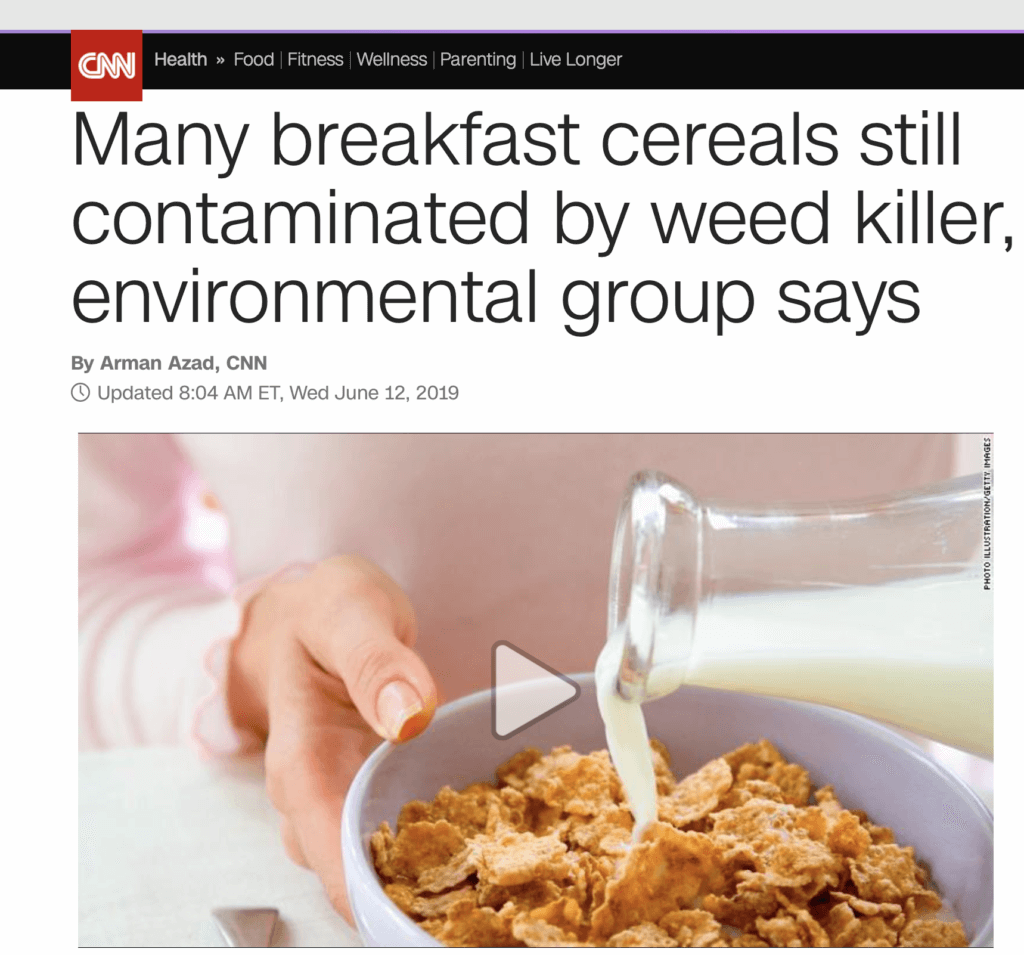
EWG’s announcement is the third of its kind focusing on the alleged dangers of glyphosate residues in our food. It was immediately trumpeted by fringe activist groups—that’s par for the course—but was also covered, almost entirely uncritically, by mainstream sources, such as CNN:

screen shot at am

What’s the news here?

Like its predecessors, released in July and October 2018, this EWG ‘study’ was based on a “round of tests” that was not peer reviewed by independent experts. Its scientists claimed that they found dozens of instances in which food it tested did not pass its “children’s health benchmark” for assessing potential exposure level hazards.

EWG did not mention that its ‘benchmark’ is entirely made up, has no clear scientific basis and is at odds with historically established and globally recognized benchmarks used by regulators in every country. The EWG “safety threshold” is 100 times lower than even the most conservative cut-off established by oversight agencies around the world, including the EPA. Curiously but not surprisingly considering EWG’s historical willingness to distort science, the threshold it settled upon just ‘happens’ to coincide with the infinitesimally trace amounts of glyphosate it found on Cheerios. ............To Read More....