 Last night (9/19/19) a mob of protestors tried to shut down CFACT’s climate rebuttal event at Georgetown University.
They shouted, blew horns, pounded on windows, and chanted over CFACT’s Marc Morano and Paul Driessen and others as they attempted to give their presentations to the packed room. Campus police were required to come in to escort the disruptors out.
I wrote you yesterday about the UN’s climate roadshow starting at Georgetown University and then coming to a crescendo in New York City this weekend and all next week. Last night’s shameless display was just the beginning of the hypocrisy and radicalism that will be on display for the world to see.
The Georgetown event was hosted by the College Republicans, who wanted to work with CFACT to offer a fact-based rebuttal to the 2-day MSNBC climate forum on campus featuring several Democratic candidates for president. The rebuttal event ran for 2 hours in between MSNBC’s coverage. CFACT's forum was featured in Newsweek.
The alarmists had two days to make wild claims. Those of us countering them with facts had two hours. That was more free speech than the Left could tolerate.
When campus police arrived the protesters obstructing the event refused to leave, saying “this is a public forum” and “we were invited to come here.”

For the radical Greens, it’s free speech for me, but not for thee.
The police tried to reason with the protesters.
In response, the disruptors chanted: “What do we want? Climate Justice! When do we want it? Now!”
Apparently, these students don’t care about justice for those in the developing world who have been denied access to the electricity, clean water, and medicines that come from a modern society flourishing from fossil fuels.
Had the protesters actually listened to Paul Driessen’s or Dr. Caleb Rossiter’s talks, they would have learned about that.
The intolerant Left cannot stand any opposition. When their assertions are countered with facts they collapse.
CFACT won't sit idly by as our freedoms are stripped away in the name of climate craziness. For nature and people too,
P.S. The climate radical roadshow moves from Georgetown to New York City this weekend and next week. CFACT is headed there now to counter the dogma emanating from the UN and their army of radical protesters at every step. Without support from our friends CFACT's work stops. Can we count on you to give whatever amount you can to help us take the field?
  | ||||
Showing posts with label Radicals. Show all posts
Showing posts with label Radicals. Show all posts
Friday, September 20, 2019
Georgetown Radicals Shout Down CFACT Forum
By Craig Rucker


Tuesday, April 16, 2019
On April 15, 'Extinction Rebellion' Broke Windows to Save Earth
By Alex Berezow — April 15, 2019
For Americans, April 15 is Tax Day. For some others around the world, April 15 is a day to block traffic and commit crimes. It’s for the environment, you see.
Extinction Rebellion, which formed in the United Kingdom in 2018, is a group dedicated to fighting against (what they incorrectly perceive to be) humanity's imminent risk of extinction. And, according to CNN, they believe the best way to accomplish that is through "non-violent" acts of civil disobedience, such as by preventing people from going to work, spraying graffiti, smashing glass doors, protesting naked, and gluing themselves to street furniture. If that doesn't save the world, what will?
The group's Facebook page declares the "bonds of the social contract to be null and void," and therefore they stand in righteous rebellion against the government. Lucky for them, they made this bold declaration in 2019 when the Queen isn't inclined to chop off their heads.
The Rebellion has a website, too, complete with vague demands:
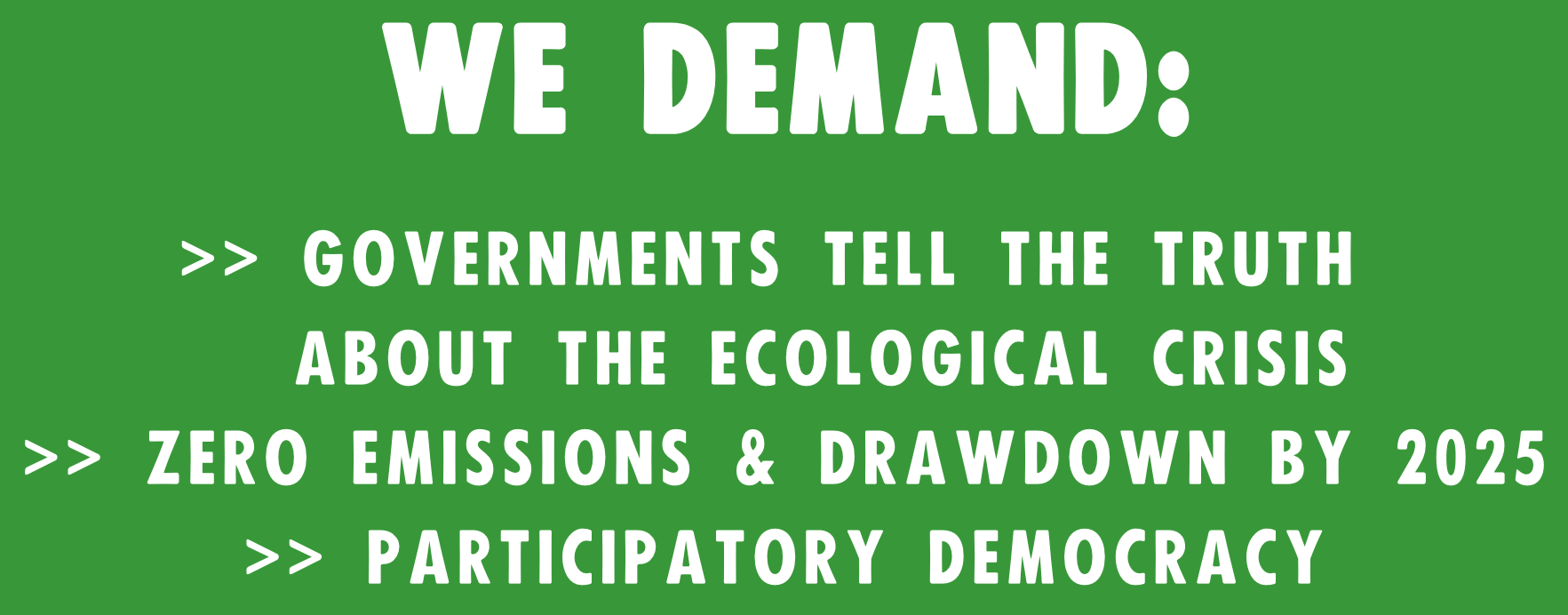
It's worth discussing these demands in more detail.
1) We demand governments tell the truth about the ecological crisis. It's extremely easy to find information about the environment. (Whether that information is reliable is another question entirely.) But assuming that Extinction Rebellion only wants to read data that is aligned with their hysterical, hair-on-fire approach to policy, they can find it just about anywhere -- scientific journals, think tanks, government websites. Nobody is hiding anything.
Besides, the fact that just about every country on Earth signed the Paris Agreement undermines their claim that governments are guilty of "criminal inaction." It's also worth noting that Germany already tried to implement a major green overhaul of its energy infrastructure called Energiewende. Spoiler it: It failed spectacularly, and Germany is nowhere close to meeting its carbon emissions target.
2) We demand zero emissions and drawdown by 2025. Good luck with that. The only realistic way to put a major dent in carbon emissions is to embrace nuclear power, but environmentalists (like those in Germany) are almost unanimously opposed to it. Apparently, the best idea they have to offer is the Green New Deal, the brainchild of Congresswoman Alexandria Ocasio-Cortez, which reads like a 4th grader's wish-list to Santa Claus. And though Ocasio-Cortez tried to deny it, an accompanying memo from her office really did propose to ban airplanes and cows:
As is so often the case, Extinction Rebellion consists of anarchists and other rebels-without-a-cause incapable of expressing a coherent thought, let alone sensible policy proposals. Like the Occupy movement that preceded it, Extinction Rebellion will make some noise then rightly fade into irrelevance.
 |
| Credit: David Holt/Wikipedia |
Extinction Rebellion, which formed in the United Kingdom in 2018, is a group dedicated to fighting against (what they incorrectly perceive to be) humanity's imminent risk of extinction. And, according to CNN, they believe the best way to accomplish that is through "non-violent" acts of civil disobedience, such as by preventing people from going to work, spraying graffiti, smashing glass doors, protesting naked, and gluing themselves to street furniture. If that doesn't save the world, what will?
The group's Facebook page declares the "bonds of the social contract to be null and void," and therefore they stand in righteous rebellion against the government. Lucky for them, they made this bold declaration in 2019 when the Queen isn't inclined to chop off their heads.
The Rebellion has a website, too, complete with vague demands:
It's worth discussing these demands in more detail.
1) We demand governments tell the truth about the ecological crisis. It's extremely easy to find information about the environment. (Whether that information is reliable is another question entirely.) But assuming that Extinction Rebellion only wants to read data that is aligned with their hysterical, hair-on-fire approach to policy, they can find it just about anywhere -- scientific journals, think tanks, government websites. Nobody is hiding anything.
Besides, the fact that just about every country on Earth signed the Paris Agreement undermines their claim that governments are guilty of "criminal inaction." It's also worth noting that Germany already tried to implement a major green overhaul of its energy infrastructure called Energiewende. Spoiler it: It failed spectacularly, and Germany is nowhere close to meeting its carbon emissions target.
2) We demand zero emissions and drawdown by 2025. Good luck with that. The only realistic way to put a major dent in carbon emissions is to embrace nuclear power, but environmentalists (like those in Germany) are almost unanimously opposed to it. Apparently, the best idea they have to offer is the Green New Deal, the brainchild of Congresswoman Alexandria Ocasio-Cortez, which reads like a 4th grader's wish-list to Santa Claus. And though Ocasio-Cortez tried to deny it, an accompanying memo from her office really did propose to ban airplanes and cows:
"We set a goal to get to net-zero, rather than zero emissions, in 10 years because we aren’t sure that we’ll be able to fully get rid of farting cows and airplanes that fast..."3) We demand participatory democracy. It's interesting how environmental activists of all stripes seem to share this feature in common: They demand democracy, by which they mean, "Vote for our policies, or we'll break your stuff." That's not democracy; that's tyrannical mob rule.
As is so often the case, Extinction Rebellion consists of anarchists and other rebels-without-a-cause incapable of expressing a coherent thought, let alone sensible policy proposals. Like the Occupy movement that preceded it, Extinction Rebellion will make some noise then rightly fade into irrelevance.
Saturday, April 22, 2017
Earth Day has become polluted by ideology and ignorance
By Jeff Stier and Henry I. Miller April 20, 2017 @ Learn Liberty, A Project of IHS
The first Earth Day celebration was conceived by then-US senator Gaylord Nelson and held in 1970 as a "symbol of environmental responsibility and stewardship." In the spirit of the time, it was a touchy-feely, consciousness-raising, New Age experience, and most activities were organized at the grassroots level.
The first Earth Day celebration was conceived by then-US senator Gaylord Nelson and held in 1970 as a "symbol of environmental responsibility and stewardship." In the spirit of the time, it was a touchy-feely, consciousness-raising, New Age experience, and most activities were organized at the grassroots level.
In recent years, Earth Day has evolved into an occasion for environmental Cassandras to prophesy apocalypse, dish antitechnology dirt, and proselytize. Passion and zeal routinely trump science, and provability takes a back seat to plausibility.
nstead of a genuine concern for nature, many of those stumping for Earth Day this April 22 will share opposition to environment-friendly advances in science and technology, such as agricultural biotechnology, fracking, and nuclear power. Another pervasive sentiment will be disdain for the capitalist system that provides the resources to expend on environmental protection and conservation. (It's no coincidence that poor countries tend to be the most polluted.)
Distortion of Science The Earth Day Network, which organizes Earth Day events and advocacy, regularly distorts science to advance its cynical agenda. This year's event, ironically enough, is dedicated to "Environmental and Climate Literacy," which is indeed sorely needed, given Earth Day's manipulation and misappropriation of our commitment to protecting the environment.
Consider, for example, the network's disingenuousness about fracking: "Fracking causes a lot of environmental harm and poses a threat to the health of a population near a fracking site due to contaminated water and the increased risk of asthma and other respiratory illnesses." In 2011, EPA Administrator Lisa Jackson conceded that she was "not aware of any proven case where the fracking process itself has affected water."
In 2013, Energy Secretary Ernest Moniz said he had "not seen any evidence of fracking per se contaminating groundwater." And just last year, the Obama EPA released the findings of its major report on fracking, which relied on 950 sources and was expected by activists to make the case against the technology.
The report was unable to cite any confirmed cases of water contamination. Under pressure from left-liberal members of Congress in the waning days of the Obama administration, the EPA changed the scientific conclusion of the draft report, which originally stated that there was "no systemic effect" on drinking water as a result of fracking.
Without any additional science or cases of contamination, EPA officials who sought to paint fracking in the worst possible light but who were confronted by the paucity of documented contamination wrote that, in "limited cases," such as in a rare fracking fluid spill, contamination could take place. In other words, not unlike riding your bike through New York's Central Park, fracking is not a zero-risk proposition.
Earth Day organizers and others pushing for across-the-board fracking bans rather than reasonable safeguards wish to "educate" us about the environment by suggesting that we should get our energy without any risk whatsoever.
Environmental Indoctrination of Children Even those who can forgive these activists for pressuring regulators and members of Congress to cook the books on scientific reports may be troubled by their campaign to indoctrinate students.
A few years ago, seventh graders at a tony private school near San Francisco were given an unusual Earth Day assignment: make a list of environmental projects that could be accomplished with Bill Gates's fortune. This approach to environmental awareness fits in well with the "progressive" worldview that the right to private property is subsidiary to undertakings that others think are worthwhile” the redistributive theory of society.
And how interesting that the resources made "available" for the students' thought experiment were not, say, the aggregate net worth of the members of Congress but the wealth of one of the nation's most successful, most innovative entrepreneurs.
Rachel Carson's Egregious Lies Another Earth Day assignment for those same students was to read Rachel Carson's best-selling 1962 book "Silent Spring, an emotionally charged but deeply flawed excoriation of the widespread spraying of chemical pesticides for the control of insects. As described by Roger Meiners and Andy Morriss in their scholarly yet eminently readable 2012 analysis, "Silent Spring" at 50: Reflections on an Environmental Classic," Carson exploited her reputation as a well-known nature writer to advocate and legitimatize "positions linked to a darker tradition in American environmental thinking: neo-Malthusian population control and anti-technology efforts."
Carson's proselytizing and advocacy led to the virtual banning of DDT and to restrictions on other chemical pesticides even though Silent Spring was replete with gross misrepresentations and scholarship so atrocious that if Carson were an academic, she would be guilty of egregious misconduct. Carson's observations about DDT were meticulously rebutted point by point by Dr. J. Gordon Edwards, a professor of entomology at San Jose State University, a longtime member of the Sierra Club and the Audubon Society, and a fellow of the California Academy of Sciences.
If Carson were an academic, she would be guilty of egregious misconduct.
In his stunning 1992 essay, "The Lies of Rachel Carson," Edwards demolished her arguments and assertions and called attention to critical omissions, faulty assumptions, and outright fabrications. Consider this from Edwards:
This implication that DDT is horribly deadly is completely false. Human volunteers have ingested as much as 35 milligrams of it a day for nearly two years and suffered no adverse effects. Millions of people have lived with DDT intimately during the mosquito spray programs and nobody even got sick as a result. The National Academy of Sciences concluded in 1965 that "in a little more than two decades, DDT has prevented 500 million [human] deaths that would otherwise have been inevitable." The World Health Organization stated that DDT had "killed more insects and saved more people than any other substance."
Meiners and Morriss conclude correctly that the influence of Silent Spring "encourages some of the most destructive strains within environmentalism: alarmism, technophobia, failure to consider the costs and benefits of alternatives, and the discounting of human well-being around the world." Sounds like the doctrine of the organizers of this year's Earth Day.
Ecofundamentalism One of the United Kingdom's great contemporary thinkers, Dick Taverne, aka Lord Taverne of Pimlico, discusses the shortcomings of New Age philosophy in his perspicacious book, "The March of Unreason. Taverne deplores the "new kind of fundamentalism" that has infiltrated many environmentalist campaigns” an undiscriminating back-to-nature movement that views science and technology as the enemy and as a manifestation of an exploitative, rapacious, and reductionist attitude toward nature. It is no coincidence, he believes, that ecofundamentalists are strongly represented in antiglobalization and anticapitalism demonstrations worldwide.
In this, Taverne echoes the late physician and novelist Michael Crichton, who argued in his much-acclaimed novel "State of Fear" that ecofundamentalists have reinterpreted traditional Judeo-Christian beliefs and myths and made a religion of environmentalism. This religion has its own Eden and paradise, where mankind lived in a state of grace and unity with nature until mankind's fall, which came not after eating a forbidden fruit, but after partaking of the forbidden tree of knowledge” that is, science. This religion also has a judgment day to come for us in this polluted world ” all of us, that is, except for true environmentalists, who will be saved by achieving "sustainability."
Environmental Alarmism One of Crichton's characters argues that since the end of the Cold War, environmental alarmism in Western nations has filled the void left by the disappearance of the terror of communism and nuclear holocaust, and that social control is now maintained by highly exaggerated fears about pollution, global warming, chemicals, genetic engineering, and the like. With the military-industrial complex no longer the primary driver of society, the politico-legal-media complex has replaced it.
This politico-legal-media complex peddles fear in the guise of promoting safety. French writer and philosopher Pascal Bruckner captured its tone nicely: "You'll get what you've got coming! That is the death wish that our misanthropes address to us. These are not great souls who alert us to troubles but tiny minds who wish us suffering if we have the presumption to refuse to listen to them. Catastrophe is not their fear but their joy."
The tiny-minded misanthropes have enjoyed some dubious "successes." They have effectively banished agricultural biotechnology from Europe, put the chemical industry on the run, and placed the pharmaceutical industry in their crosshairs.
Lord Taverne believes these are ominous trends that are contrary to the principles of the Enlightenment, returning us to an era in which inherited dogma and superstition took precedence over experimental data. Not only do the practices of ecofundamentalism retard technologies and the availability of products which, used responsibly, could dramatically improve and extend many lives and protect the environment, but they strangle scientific creativity and technological innovation.
A Defense of Science, Reason, and Democracy With Congress, the administration, and many Americans now firmly on the side of more sensible, more limited regulation, it would behoove the Earth Day activists to collaborate in good faith and to support advances in environment-friendly technologies and business models. Among these, we would include ridesharing services, Airbnb, modern genetic engineering applied to agriculture, and state-of-the art agricultural chemicals, all of which enable us to do more with less but have been vilified by activists.
We are not sufficiently naive to expect that to happen. Rather, we suspect that activists' ecofundamentalism will continue to undermine the health of civilized society and of democracy.
Lord Taverne observed that when you defend science and reason, you defend democracy itself. Well said, Milord, and happy Earth Day to you.
Henry I. Miller, a physician and molecular biologist, is the Robert Wesson Fellow in Scientific Philosophy and Public Policy at Stanford University's Hoover Institution. He was the founding director of the FDA's Office of Biotechnology. Jeff Stier is a senior fellow at the National Center for Public Policy Research in Washington, DC, and heads its Risk Analysis Division.
nstead of a genuine concern for nature, many of those stumping for Earth Day this April 22 will share opposition to environment-friendly advances in science and technology, such as agricultural biotechnology, fracking, and nuclear power. Another pervasive sentiment will be disdain for the capitalist system that provides the resources to expend on environmental protection and conservation. (It's no coincidence that poor countries tend to be the most polluted.)
Distortion of Science The Earth Day Network, which organizes Earth Day events and advocacy, regularly distorts science to advance its cynical agenda. This year's event, ironically enough, is dedicated to "Environmental and Climate Literacy," which is indeed sorely needed, given Earth Day's manipulation and misappropriation of our commitment to protecting the environment.
Consider, for example, the network's disingenuousness about fracking: "Fracking causes a lot of environmental harm and poses a threat to the health of a population near a fracking site due to contaminated water and the increased risk of asthma and other respiratory illnesses." In 2011, EPA Administrator Lisa Jackson conceded that she was "not aware of any proven case where the fracking process itself has affected water."
In 2013, Energy Secretary Ernest Moniz said he had "not seen any evidence of fracking per se contaminating groundwater." And just last year, the Obama EPA released the findings of its major report on fracking, which relied on 950 sources and was expected by activists to make the case against the technology.
The report was unable to cite any confirmed cases of water contamination. Under pressure from left-liberal members of Congress in the waning days of the Obama administration, the EPA changed the scientific conclusion of the draft report, which originally stated that there was "no systemic effect" on drinking water as a result of fracking.
Without any additional science or cases of contamination, EPA officials who sought to paint fracking in the worst possible light but who were confronted by the paucity of documented contamination wrote that, in "limited cases," such as in a rare fracking fluid spill, contamination could take place. In other words, not unlike riding your bike through New York's Central Park, fracking is not a zero-risk proposition.
Earth Day organizers and others pushing for across-the-board fracking bans rather than reasonable safeguards wish to "educate" us about the environment by suggesting that we should get our energy without any risk whatsoever.
Environmental Indoctrination of Children Even those who can forgive these activists for pressuring regulators and members of Congress to cook the books on scientific reports may be troubled by their campaign to indoctrinate students.
A few years ago, seventh graders at a tony private school near San Francisco were given an unusual Earth Day assignment: make a list of environmental projects that could be accomplished with Bill Gates's fortune. This approach to environmental awareness fits in well with the "progressive" worldview that the right to private property is subsidiary to undertakings that others think are worthwhile” the redistributive theory of society.
And how interesting that the resources made "available" for the students' thought experiment were not, say, the aggregate net worth of the members of Congress but the wealth of one of the nation's most successful, most innovative entrepreneurs.
Rachel Carson's Egregious Lies Another Earth Day assignment for those same students was to read Rachel Carson's best-selling 1962 book "Silent Spring, an emotionally charged but deeply flawed excoriation of the widespread spraying of chemical pesticides for the control of insects. As described by Roger Meiners and Andy Morriss in their scholarly yet eminently readable 2012 analysis, "Silent Spring" at 50: Reflections on an Environmental Classic," Carson exploited her reputation as a well-known nature writer to advocate and legitimatize "positions linked to a darker tradition in American environmental thinking: neo-Malthusian population control and anti-technology efforts."
Carson's proselytizing and advocacy led to the virtual banning of DDT and to restrictions on other chemical pesticides even though Silent Spring was replete with gross misrepresentations and scholarship so atrocious that if Carson were an academic, she would be guilty of egregious misconduct. Carson's observations about DDT were meticulously rebutted point by point by Dr. J. Gordon Edwards, a professor of entomology at San Jose State University, a longtime member of the Sierra Club and the Audubon Society, and a fellow of the California Academy of Sciences.
If Carson were an academic, she would be guilty of egregious misconduct.
In his stunning 1992 essay, "The Lies of Rachel Carson," Edwards demolished her arguments and assertions and called attention to critical omissions, faulty assumptions, and outright fabrications. Consider this from Edwards:
This implication that DDT is horribly deadly is completely false. Human volunteers have ingested as much as 35 milligrams of it a day for nearly two years and suffered no adverse effects. Millions of people have lived with DDT intimately during the mosquito spray programs and nobody even got sick as a result. The National Academy of Sciences concluded in 1965 that "in a little more than two decades, DDT has prevented 500 million [human] deaths that would otherwise have been inevitable." The World Health Organization stated that DDT had "killed more insects and saved more people than any other substance."
Meiners and Morriss conclude correctly that the influence of Silent Spring "encourages some of the most destructive strains within environmentalism: alarmism, technophobia, failure to consider the costs and benefits of alternatives, and the discounting of human well-being around the world." Sounds like the doctrine of the organizers of this year's Earth Day.
Ecofundamentalism One of the United Kingdom's great contemporary thinkers, Dick Taverne, aka Lord Taverne of Pimlico, discusses the shortcomings of New Age philosophy in his perspicacious book, "The March of Unreason. Taverne deplores the "new kind of fundamentalism" that has infiltrated many environmentalist campaigns” an undiscriminating back-to-nature movement that views science and technology as the enemy and as a manifestation of an exploitative, rapacious, and reductionist attitude toward nature. It is no coincidence, he believes, that ecofundamentalists are strongly represented in antiglobalization and anticapitalism demonstrations worldwide.
In this, Taverne echoes the late physician and novelist Michael Crichton, who argued in his much-acclaimed novel "State of Fear" that ecofundamentalists have reinterpreted traditional Judeo-Christian beliefs and myths and made a religion of environmentalism. This religion has its own Eden and paradise, where mankind lived in a state of grace and unity with nature until mankind's fall, which came not after eating a forbidden fruit, but after partaking of the forbidden tree of knowledge” that is, science. This religion also has a judgment day to come for us in this polluted world ” all of us, that is, except for true environmentalists, who will be saved by achieving "sustainability."
Environmental Alarmism One of Crichton's characters argues that since the end of the Cold War, environmental alarmism in Western nations has filled the void left by the disappearance of the terror of communism and nuclear holocaust, and that social control is now maintained by highly exaggerated fears about pollution, global warming, chemicals, genetic engineering, and the like. With the military-industrial complex no longer the primary driver of society, the politico-legal-media complex has replaced it.
This politico-legal-media complex peddles fear in the guise of promoting safety. French writer and philosopher Pascal Bruckner captured its tone nicely: "You'll get what you've got coming! That is the death wish that our misanthropes address to us. These are not great souls who alert us to troubles but tiny minds who wish us suffering if we have the presumption to refuse to listen to them. Catastrophe is not their fear but their joy."
The tiny-minded misanthropes have enjoyed some dubious "successes." They have effectively banished agricultural biotechnology from Europe, put the chemical industry on the run, and placed the pharmaceutical industry in their crosshairs.
Lord Taverne believes these are ominous trends that are contrary to the principles of the Enlightenment, returning us to an era in which inherited dogma and superstition took precedence over experimental data. Not only do the practices of ecofundamentalism retard technologies and the availability of products which, used responsibly, could dramatically improve and extend many lives and protect the environment, but they strangle scientific creativity and technological innovation.
A Defense of Science, Reason, and Democracy With Congress, the administration, and many Americans now firmly on the side of more sensible, more limited regulation, it would behoove the Earth Day activists to collaborate in good faith and to support advances in environment-friendly technologies and business models. Among these, we would include ridesharing services, Airbnb, modern genetic engineering applied to agriculture, and state-of-the art agricultural chemicals, all of which enable us to do more with less but have been vilified by activists.
We are not sufficiently naive to expect that to happen. Rather, we suspect that activists' ecofundamentalism will continue to undermine the health of civilized society and of democracy.
Lord Taverne observed that when you defend science and reason, you defend democracy itself. Well said, Milord, and happy Earth Day to you.
Henry I. Miller, a physician and molecular biologist, is the Robert Wesson Fellow in Scientific Philosophy and Public Policy at Stanford University's Hoover Institution. He was the founding director of the FDA's Office of Biotechnology. Jeff Stier is a senior fellow at the National Center for Public Policy Research in Washington, DC, and heads its Risk Analysis Division.
Subscribe to:
Posts (Atom)