Search This Blog

De Omnibus Dubitandum - Lux Veritas

Showing posts with label Birds. Show all posts

Monday, December 19, 2022

Alternative Energy: Myth, Fact and Hyperbole

Astronomical battery cost looms over “renewables” - By |December 15th, 2022| Energy| 230 Comments - The amount of storage needed to make renewables reliable is so huge that even if the cost dropped fantastically we still could not afford it.

We now know that the battery storage for the entire American grid is impossibly expensive, thanks to a breakthru study by engineer Ken Gregory. Looking at several recent years he analyzed, on an hour by hour basis, the electricity produced with fossil fuels. He then calculated what it would have taken in the way of storage to produce the same energy using wind and solar power. He did this by scaling up those year’s actual wind and solar production.

Based on his work, which only covered 48 states, our round working estimate of the required storage for the whole country is an amazing 250 million MWh. America today has less than 20 thousand MWh of grid scale battery storage, which is next to nothing.

Grid scale batteries today cost around $700,000 a MWh. For 250 million MWh we get an astronomical total cost of $175 trillion dollars just to replace today’s fossil fuel generated electricity needs with wind and solar. Even the fantastically low cost estimates that some people are proposing puts the cost around the total annual GDP of America. Even worse, if we get the electric cars and trucks the Biden Administration is calling for these astronomical numbers could easily double.

The environmental cost of wind and solar in NetZero - By  December 14th, 2022|General Information|174 Comments - Birds, bats, whales, even people pay the price. Cats, the BBC tells us, kill more birds than wind turbines. And they are right.

But unlike cats, notes British journalist Matt Ridley, all over the world, the largest and rarest eagles and vultures are dying in significant numbers as a result of wind turbines. — wedge-tailed eagles in Australia, Verreaux’s eagles in South Africa, sea eagles in Norway, and bald and golden eagles in the United States.

Ridley notes that a32-turbine wind power station in Spain kills a vulture every three days – decimating rare populations of griffon, cincerous, bearded, and Egyptian vultures. In California’s Altamont Pass wind turbines kill over 1,000 birds of prey each year. A Norwegian wind power station has reduced the number of sea eagle territories on the island of Smola from thirteen to just five – making local extinction a real possibility................

Tasmanian mega wind farm approved that can’t operate half the year - By - When does it make sense to build 122 giant industrial turbines that can’t operate for nearly half a year?  he EPA has approved Robbins Island Mega Wind Factory in a remote island off Tasmania that will have to stop working for five months of the year so it doesn’t hurt the Orange-bellied Parrot. It will however be able to kill eagles and other birds for the other seven months of the year.  Green electrons are revered, Orange-bellied parrots are sacred but our way of life is up for grabs. It’s a cult.

This is infrastructure that only works about 30% of the time anyhow, and now will be reduced to something like 17%. The theoretical capacity will be 340MW in the first stage, supposedly growing to 900MW if they can somehow build the extra 170km transmission lines and perhaps get the taxpayer to help build another undersea cable across the Bass Strait. (If the company was going to pay, why was the Tasmanian government spending $20m on the “business case”?)

It will be one of the largest wind factories in the Southern Hemisphere (the biggest being West of Melbourne), but as Tom Quirk showed years ago, when the wind stops in Tasmania it often also stops in Victoria. So the two giant wind factories with supposedly 2GW of random unreliable power between them will both probably be useless together.  In 2019, this mega industrial proposal was the point where the Greens suddenly realized that skeptics were right and wind-farms were ugly bird killers..........

CFACT’s Morano on OAN TV “praises” Biden’s fossil fuel ban in fed buildings - By |December 13th, 2022|CFACT TV, Regulation|82 Comments -  CFACT’s Marc Morano, editor of Climate Depot, appeared on OAN TV’s “In Focus” with Addison Smith to address the Biden Administration’s plans to eliminate the use of fossil fuels in federal buildings.

“This is actually one thing we should wholeheartedly support President Biden. He’s talking about eliminating fossil fuels in federal buildings and new construction renovation and existing buildings,” Morano said. “This is the first conservative thing Joe Biden has done. He is going to make federal workers live in a Net Zero world that means when August heat waves hit DC and air conditioning isn’t going to be sufficiently powered by solar, and wind and renewable, bureaucrats are going to be too uncomfortable to think of even more regulations.”

“A less efficient bureaucracy is what we actually want in Washington and I can’t think of anything more distasteful or unpleasant to impose on federal bureaucrats than working in miserably powered buildings by energy that can’t possibly power them well.”

Watch the full segment here.

Sunday, June 23, 2019

Growing evidence of wind farms’ horrific toll on wildlife: This time from India

Wind Turbines: The New “Apex Predator”

2019-06-19 By Bonner Cohen, Ph. D.|General Information|3 Comments  @ CFACT 
Eagles, hawks, bats – these are among the most prominently cited avian wildlife regularly slaughtered by industrial-sized wind-power facilities that – thanks to taxpayer subsidies and state renewable-energy mandates — continue to spread like wildfire across rural America.


The affliction is by no means restricted to the United States, however. A new study sheds light on the carnage giant wind turbines are inflicting on wildlife in India. Researchers at the Indian Institute for Science at Bengaluru studied bird and lizard populations at three wind turbine sites in Western Ghats. They found that the mass killing of avian predators by wind turbines is having a “ripple effect” across the food chain, with lizards and small mammals adjusting to substantially reduced numbers of predators in the sky

Wind Turbines: The New “Apex Predator”

As reported by the Daily Mail last November (and otherwise largely ignored by the media), researchers in India found almost four times fewer buzzards, hawks, and kites in areas with wind farms – a loss of about 75%. Startled by the data, scientists are now referring to wind turbines as “the new apex predator.”

In areas without wind turbines about 19 birds were spotted every three hours, while in areas with the spinning blades the number dropped to five. Fewer winged predators have been good news for the fan-throated lizard, a species found only in certain areas of the Indian Sub-Continent. The lizard is usually easy pickings for hawks, buzzards, and other birds, but with their numbers reduced by the wind turbines, the lizard’s numbers are multiplying.

“We have known from many studies that wind turbines kill birds and bats. They kill them and disrupt their movement. But we took that one step further and discovered that it affects lizards, too,” study coauthor Maria Thaker told the Daily Mail.

“Every time a top predator is removed or added, unexpected effect trickle through the ecosystem,” she added. “What is actually happening here is that wind turbines are akin to adding a top predator to the ecosystem.”

The study, which was published in Nature Ecology and Evolution, compared populations of raptors and lizards on a plateau that has had a wind farm on it for about 20 years to an adjacent valley that has no turbines.

“Humankind’s Most Pervasive Influence on the Natural World”

A recent study by an international team of scientists found the decline of apex predators is” arguably humankind’s most pervasive influence on the natural world.”

None of this is of any real concern to green groups, such as the World Wildlife Fund, who parrot the party line that the real threat to wildlife is “climate change,” not industrial-scale wind facilities and giant solar arrays they have been supporting for decades.

While India has made great strides in electrification in recent years, much still needs to be done. According to official data, “only 1,417 of India’s 18,452 villages or 7.3% of the total, have 100% household connectivity, and about 31% are still in the dark,” Forbes reported last year.

India’s future should not be dependent on interment, unreliable, unaffordable, and, as we now know, environmentally destructive wind power.

Author

Sunday, November 18, 2018

Viewpoint: As global honeybee population increases, activists blame neonicotinoid pesticides for ‘bird-pocalypse’ that’s not happening

| @ | November 13, 2018

Are we in the midst of another bout of unfounded environmentalist-fueled exaggerations—this time about birds becoming extinct because of pesticide exposure?

We’ve seen this script most recently, with hyped fears about the demise of the honeybee. Anti-pesticide activists abetted by some mostly inexperienced bee keeper newbies, claimed that honeybee populations in Europe and North America were collapsing as a result of a mysterious condition that came to be known as ‘colony collapse disorder’. CCD, mostly concentrated in California in 2006-07, was marked by a unique condition in which worker honeybees suddenly abandoned otherwise healthy-seeming hives for no apparent reason. It remains a genuine mystery, although research has turned up similar collapses that have occurred periodically and inexplicably in Europe over the past few centuries.

CCD was followed by a series of severe winters that led to higher-than-usual overwinter bee deaths, fueling genuine concerns among scientists about bee health. The issue soon migrated into the mainstream media when anti-GMO and anti-chemical groups aligned to blame pesticides for both CCD and the overwinter losses, and by-and-large refused to recognize the complexity of bee life and bee health.

Politicization of the ‘bee crisis’

Most of the finger-pointing was initially directed at a class of pesticides developed in the 1990s—neonicotinoids—that were designed specifically to replace organophosphates, pyrethrins and pyrethroid insecticides, which are highly toxic to mammals and beneficial insects, including bees. From this sprang an entire cottage industry of (mostly laboratory) studies by some activist-oriented scientists that appeared to be designed more to prove a case than explore a mystery.

The politicization of what should have been a science-based issue culminated in the European Union’s decision earlier this year to expand its 2013 partial ban on these insecticides to cover all outdoor uses—which has led to the reintroduction of the more toxic chemicals phased out in the 1990s.

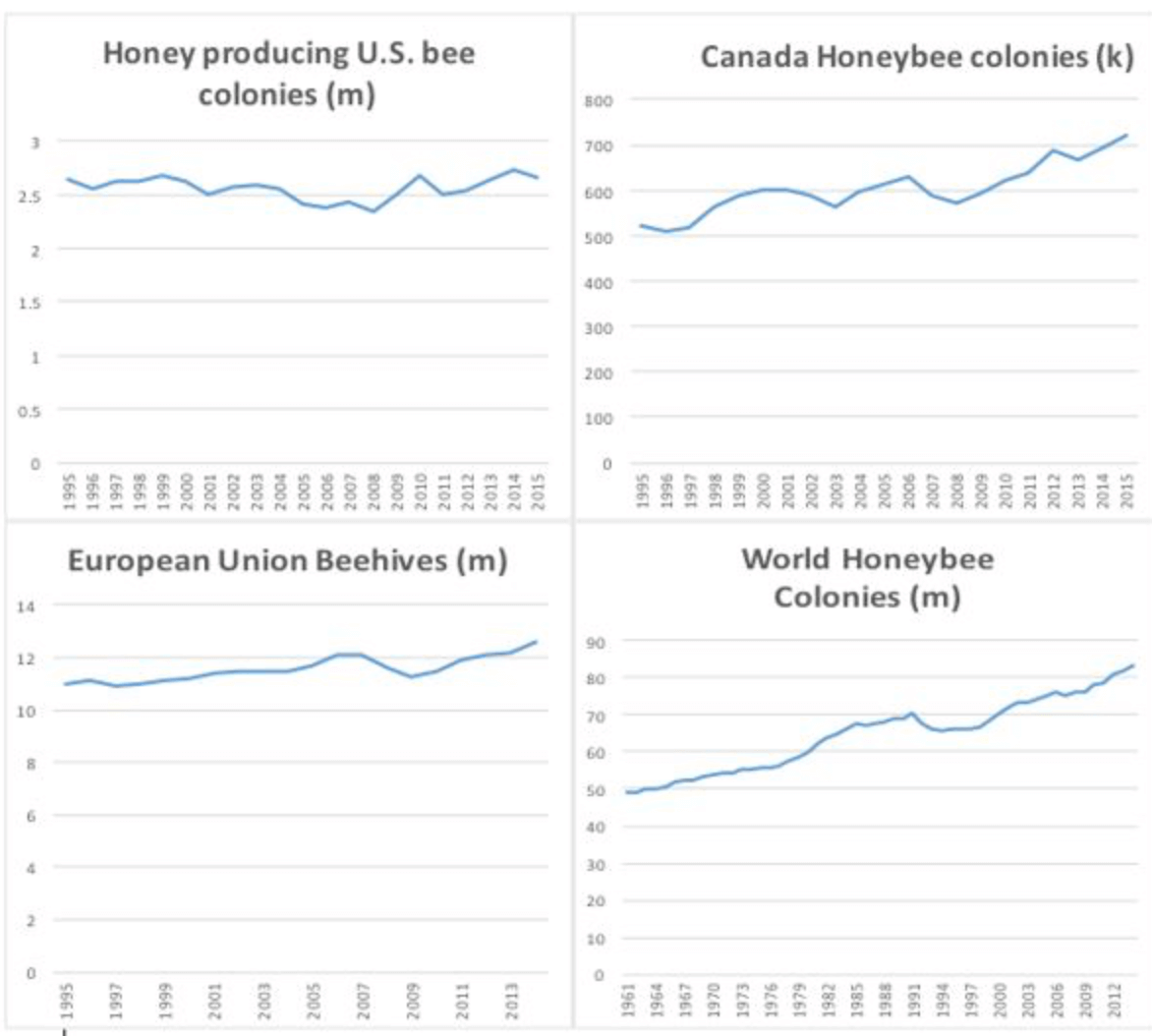
It’s now widely accepted that honeybee populations aren’t collapsing after all, with populations steady or rising in Europe and North America for the last 20 years—and rising worldwide for more than a half-century, as even the Sierra Club now grudgingly acknowledges.
…honeybees are at no risk of dying off. While disease, parasites, and other threats are certainly real problems for beekeepers, the total number of managed honeybees worldwide has risen by 45 percent over the last half century 
What threatens bee health?

We now have a pretty good idea of what drove the higher-than-normal health problems that existed after the CCD scare : the Varroa destructor mite infestations of hives combined with widespread prevalence of a honeybee gut fungus called nosema ceranae. It should be noted the experts agree that rising global honeybee colony numbers do not mean that bees are not struggling; in fact there is general agreement that bee health is a serious issue, but pesticides are a comparatively minor threat compared to the host of diseases and the overuse of miticides to fight some of the challenges. In Australia where neonics are widely used, and Varroa and nosema are health, bee health is not an issue.

Bees are seen by farmers and professional beekeepers as, essentially, livestock but in the wake of the extinction scares, bees have taken on almost a romantic, mythical status among the public and hobby bee keepers. That goes a long way to explaining why no activist campaign has been launched to eradicate Varroa and the nosema fungus. First, they are both extremely difficult to combat. The mites, in particular, have rapidly developed resistance to every synthetic chemical mite treatment yet devised. What’s more, poor mite-control practices by amateur beekeepers who refuse to treat their mite problems with effective chemicals has had the effect of turning their collapsing hives into escalating sources of contagious infestation for neighboring beekeepers’ hives.

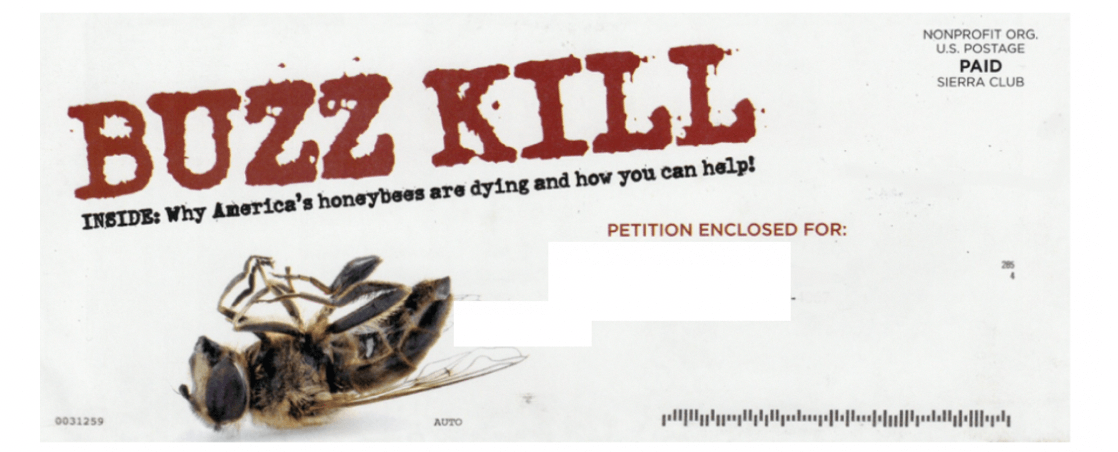
But more to the point, focusing attention on a combination of complex factors doesn’t have the pizazz of finding any easy bogeyman like pesticides. The anti-chemical hysteria also has helped fill an expanding piggybank for advocacy groups for years now. Consider the Sierra Club again. Even as it was proclaiming an end to its own bee-pocalypse hysteria, it launched a fund-raising campaign designed to raise money by scaring the public with dire warnings that pesticides were on the verge of wiping out bees. This Sierra Club fund raising flyer arrived at my house.


Now ‘threatened’ birds provide a new scare opportunity

In April, a pair of studies from France—one regionally focused, one nationwide—claimed widespread declines in European populations of field birds. The studies, which were not yet released, reportedly attributed these declines to modern agricultural practices, specifically, the widespread use of the same neonicotinoid pesticides blamed for the non-existent ‘bee-pocalypse’.

Articles about these studies appeared widely last spring, including in the New York Times, and the spate of stories persisted for weeks. The studies, however, remain unpublished today—suggesting a novel form of advocacy for activist environmental scientists: leak or brief your sensational results to the press to generate media attention while keeping a controversial study, and the data on which the advertised findings depend, under wraps. The peer-reviewed data that led to headlines around the world might in fact never be released.

Understandably, the stories fueled a new anxiety over neonic pesticides: They threaten bird population along with the bees.

In late summer, another study from the team of Saskatchewan-based scientist Christy Morrissey, known for her anti-neonic views, sought to demonstrate that birds (in this case tree swallows) that catch their insect prey in flight were being adversely affected by a dearth of aquatic insects. Those insects, it was assumed, were being decimated by the run off of neonicotinoid pesticides from farm lands into freshwater rivers, streams, lakes and ponds.

As it happens, the study didn’t confirm this hypothesis; it actually demonstrated much the opposite: It found that tree swallows were enjoying even richer diets of aquatic insects. So, whatever was happening in all those streams and ponds, neonics weren’t affecting the abundance of aquatic insect meals for insectivorous birds.

Morrissey’s team did, however, find something else in their data that they characterized as a neonic-caused calamity: Tree swallows foraging in cropland exhibited lower body weight than those foraging in grasslands. Morrissey speculated that these birds were ‘struggling’ as neonic-treated croplands left them with a scantier insect diet. This she wrote, is what has led to a fall-off in the birds’ overall numbers.

What is the status of bird health in North America?

But there are questions as to this purely speculative conclusion. We know what the main killers of birds are, and they aren’t pesticides:
  • By far, scientists say, the greatest challenge to bird populations is habitat loss—which is mostly attributed to ‘urban sprawl’— the conversion of rural acreage, whether farm or forest, to (sub)urbanization. The parallel here to Varroa and bees is unmistakable: We know the main problem but since it’s complicated and doesn’t lend itself to a facile solution, let’s not acknowledge or analyze it.
  • Other man-made environmental challenges, such as windmills and high-voltage electric lines crisscrossing the rural landscape, kill up to a billion or more birds annually. The US Fish & Wildlife Service estimates that collisions with high-voltage electric lines alone kill 174 million birds per year. In-flight collisions with skyscrapers and other buildings kill between 97 million and 976 million birds per year in the US. Collisions with cars account for another roughly 60 million bird fatalities. The list goes on.
  • Cats have been estimated to kill an astounding 1.3 billion and 3.7 billion birds per year.  
As for the threat from neonicotinoid-treated seeds, they have been shown to have low toxicity to birds. Vertebrate nervous systems are much less susceptible to nicotine and synthetic compounds that mimic the disruptive effects on the nicotinic acetylcholine receptors essential to the functioning of insect nervous systems. Moreover, birds generally avoid the tiny fraction (1% is deemed permissible under EPA rules) of neonic-treated seeds that may remain on the ground after mechanical planting, due perhaps to their altered appearance (many are colored), smell or taste.  

The most common of these treated seeds, corn, is, in any case, too large for small and medium-sized birds to ingest and too hard for them to crack with their beaks. All of which may help explain why such research as we have seen trying to link the supposed ‘devastation’ of bird populations to pesticides hasn’t focused on the effects of direct ingestion by birds; instead, as with Christy Morrissey’s team’s most recent study, the effort appears designed to demonstrate some indirect effect on bird populations from indiscriminate adverse impacts on the birds’ insect food sources.  
How badly are birds actually fairing? Is the bird-pocalypse any more reality-based than the bee version? Ultimately, all of these claims about the supposed imminent extinction of some species or other—honeybees a few years ago; field birds today—depend on a lack of context driven, it appears, by ideology.  

There is, in fact, a good deal of evidence that birds in general are in pretty good shape in the US. Numerous studies have documented a gradual decline of bird populations in the US and the developed world, but as in the case of bee population fall-off, these declines occurred in the


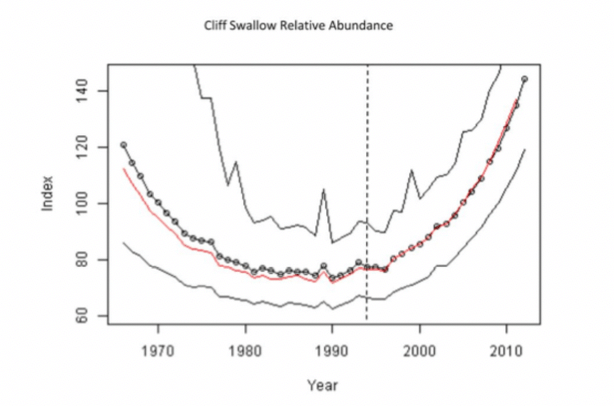
decades before the large-scale introduction of neonicotinoid pesticides in the late 1990s. As the Genetic Literacy Project reported some years ago, many bird populations seem to have leveled off during the last two decades and have in many cases increased since the 1990s. Bird populations don’t appear to have been impacted since their introduction.

What about other pesticides? Bird deaths directly attributable to pesticides—all pesticides, not just neonics—have been estimated to total 76 million annually. (An unknown additional number die from other indirect effects.) That’s about three-quarters of 1% of the day-to-day bird population in the US or three-eighths of 1% of the peak autumn bird population. Clearly, they are not a major driver of bird population trends, as so many other factors, including ‘natural causes’, result in far more bird fatalities annually.

Stampeding policy-makers on the basis of mischaracterized, misdiagnosed, half-understood supposed problems into adopting measures that won’t, in any case, solve them is a prescription for dreadful decisions.

Jon Entine, executive director of the Genetic Literacy Project, has been a journalist for more than 40 years as a writer, network television news producer and author of seven books, four on genetics and risk. BIO. Follow him on Twitter @JonEntine

Sunday, February 4, 2018

Trump’s Interior Department seeks to end abuse of migratory bird treaty Act

by , 1 Comment

Continuing its systematic rollback of Obama-era policies and regulations that centralized power in the hands of Washington bureaucrats and their political allies, the Trump administration is moving to bring much-needed clarity to a century-old bird-protection statute whose enforcement has vexed courts and government officials for decades.

The original Migratory Bird Treaty Act (MBTA) of 1918 was enacted to implement the 1916 Convention with Great Britain (for Canada) for the protection of migratory birds whose flyways traverse international borders. Through amendments over the years, the MBTA now covers implementation of similar treaties between the U.S. and Mexico, the U.S. and Japan, and the U.S. and the Soviet Union (now Russia).

Administered by the Interior Department’s Fish and Wildlife Service (FWS), the law makes it illegal to “pursue, hunt, take, [or] capture” any migratory bird “by any means whatever [and] at any time or any manner.”...........To Read More.....